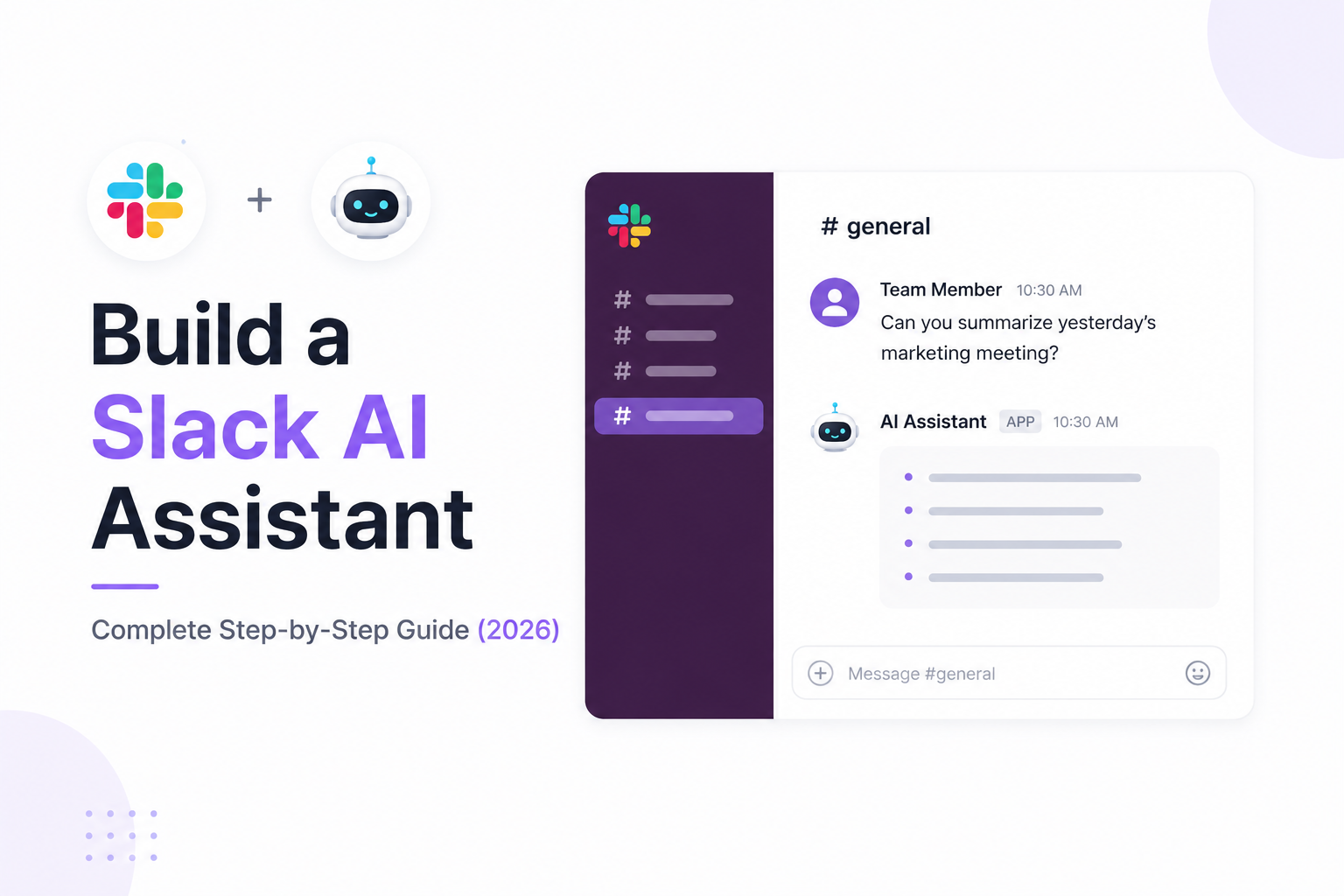
Build a Slack AI Assistant: Complete Step-by-Step Guide (2026)
Slack has become the communication hub for modern businesses. Teams use it for collaboration, project management, customer support, engineering discussions, HR communication, and daily operations.
As organizations grow, employees spend more time searching for information, answering repetitive questions, switching between tools, and managing workflows.
An AI-powered Slack Assistant solves these problems by acting as an intelligent teammate.
Instead of simply replying to messages, the assistant can search company knowledge, summarize discussions, retrieve documents, answer employee questions, trigger workflows, and integrate with business systems.
In this guide, you'll learn how to build a production-ready Slack AI Assistant using Python and modern AI technologies.
---
What is a Slack AI Assistant?
A Slack AI Assistant is an intelligent AI Agent that works directly inside Slack.
Unlike simple chatbots, it can:
- Understand natural language
- Search company documentation
- Answer employee questions
- Summarize conversations
- Generate reports
- Use external tools
- Access databases
- Automate business workflows
It becomes an intelligent digital coworker rather than a simple messaging bot.
---
What Will We Build?
Our AI Assistant will be capable of:
- Answering employee questions
- Searching internal documentation
- Summarizing Slack conversations
- Creating meeting notes
- Automating HR workflows
- Creating support tickets
- Updating CRM records
- Connecting with external APIs
This same architecture can later power internal copilots, IT assistants, HR assistants, and enterprise AI Agents.
---
System Architecture
A production-ready Slack AI Assistant follows this architecture:
Employee
↓
Slack Workspace
↓
Slack Events API
↓
Webhook Server
↓
Python Backend
↓
Large Language Model
↓
Business Tools
↓
Knowledge Base
↓
Response Returned in Slack
Each layer performs a specific role, making the system scalable and easy to maintain.
---
Step 1: Create a Slack App
Begin by creating a Slack App for your workspace.
The app will provide secure credentials that allow your backend to communicate with Slack.
Store these credentials securely using environment variables.
Never expose tokens inside frontend applications.
---
Step 2: Configure Event Subscriptions
Slack sends events whenever users interact with your assistant.
Examples include:
- New Messages
- Mentions
- Slash Commands
- Button Clicks
- Workflow Events
These events are delivered to your backend through secure webhooks.
---
Step 3: Build the Backend
The backend handles all AI processing.
Its responsibilities include:
- Receiving Slack events
- Managing conversations
- Calling AI models
- Executing tools
- Logging interactions
- Returning responses
Python frameworks such as FastAPI are widely used for production deployments.
---
Step 4: Connect an AI Model
The backend communicates with a Large Language Model.
Popular options include:
- OpenAI
- Anthropic Claude
- Google Gemini
- Llama
- DeepSeek
- Mistral
The selected model interprets employee requests and generates intelligent responses.
---
Step 5: Add Conversation Memory
Memory enables the assistant to remember previous interactions.
Examples include:
- Previous discussions
- User preferences
- Open tasks
- Ongoing projects
- Conversation history
This creates more natural and context-aware interactions.
---
Step 6: Add RAG
Most companies maintain large knowledge bases.
Using Retrieval-Augmented Generation (RAG), the assistant can search:
- Company Documentation
- SOPs
- Employee Handbook
- API Documentation
- Engineering Wiki
- Product Guides
- HR Policies
Employees receive accurate answers without manually searching through multiple systems.
---
Step 7: Connect Business Tools
A powerful Slack AI Assistant should perform actions, not just answer questions.
Examples include:
- Create Jira tickets
- Send emails
- Schedule meetings
- Retrieve CRM records
- Search databases
- Generate reports
- Create GitHub issues
- Update project status
These integrations make the assistant a valuable productivity tool.
---
Step 8: HR and IT Automation
Many internal requests are repetitive.
The assistant can automate:
HR
- Leave policies
- Holiday calendars
- Benefits information
- Onboarding guidance
---
IT
- Password reset guidance
- Software access requests
- Knowledge search
- Incident reporting
Employees receive instant assistance while reducing the workload on HR and IT teams.
---
Step 9: Meeting Summaries
Long Slack discussions often contain valuable decisions.
The AI can automatically:
- Summarize conversations
- Highlight action items
- Identify deadlines
- Assign responsibilities
- Generate meeting notes
This improves team productivity.
---
Step 10: Workflow Automation
Slack AI can automate complete business workflows.
Example:
Employee requests software access
↓
AI verifies request
↓
Creates IT Ticket
↓
Notifies IT Team
↓
Updates Employee
↓
Logs Request
↓
Confirms Completion
Entire internal processes can run automatically.
---
Step 11: Human Escalation
Some situations require human involvement.
The assistant should escalate when:
- Approval is required
- Sensitive HR issues arise
- Security concerns are detected
- Complex technical problems occur
- Users request human assistance
This ensures employees always receive appropriate support.
---
Deployment
Production deployments commonly use:
- Docker
- AWS
- Google Cloud
- Azure
- Railway
- Render
- Kubernetes
Monitoring, logging, and backups should be enabled before deployment.
---
Security Best Practices
Slack assistants often access confidential business information.
Recommended practices include:
- Secure API tokens
- Encrypt sensitive data
- Validate Slack requests
- Apply role-based permissions
- Log important activities
- Monitor system usage
- Rotate credentials regularly
Strong security is essential for enterprise deployments.
---
Common Use Cases
Businesses use Slack AI Assistants for:
Internal Knowledge Search
Employees find answers instantly.
---
Engineering Teams
Search documentation and automate development workflows.
---
HR Support
Answer policy questions and assist employees.
---
Customer Support
Summarize tickets and coordinate support teams.
---
Project Management
Generate task summaries and monitor progress.
---
Executive Teams
Create daily reports and summarize organizational updates.
---
Common Mistakes
Developers often encounter issues such as:
- Missing conversation memory
- Weak permission controls
- Poor prompt engineering
- Missing webhook validation
- Hardcoded credentials
- No human escalation
- Ignoring monitoring
Planning these areas early leads to more reliable systems.
---
Recommended Tech Stack
A production-ready Slack AI Assistant can use:
- Python
- FastAPI
- OpenAI or Claude
- LangGraph
- PostgreSQL
- Redis
- Pinecone or Qdrant
- Docker
- Slack API
- React Admin Dashboard
This stack supports scalable enterprise AI applications.
---
Future Enhancements
Slack AI Assistants will continue evolving with features such as:
- Voice interactions
- Multi-Agent collaboration
- AI meeting facilitators
- Enterprise search across multiple tools
- Predictive workflow automation
- MCP integration
- Intelligent project management
These capabilities will further improve workplace productivity.
---
Final Thoughts
A Slack AI Assistant can become one of the most valuable productivity tools inside an organization.
By combining Slack, Python, Large Language Models, Retrieval-Augmented Generation, workflow automation, and business integrations, companies can reduce repetitive work, improve collaboration, and give employees instant access to the information they need.
Whether you're building an internal knowledge assistant, an HR copilot, or an enterprise AI Agent, Slack provides an excellent platform for intelligent workplace automation.
---
Ready to Build a Slack AI Assistant?
At WyndrelLabs, we develop enterprise-grade Slack AI Assistants tailored to modern businesses.
From internal knowledge assistants and AI Agents to HR automation, IT support, workflow automation, CRM integrations, and RAG-powered enterprise search, we build secure and scalable solutions that help teams work smarter.
Book a free consultation today and discover how a Slack AI Assistant can transform productivity across your organization.