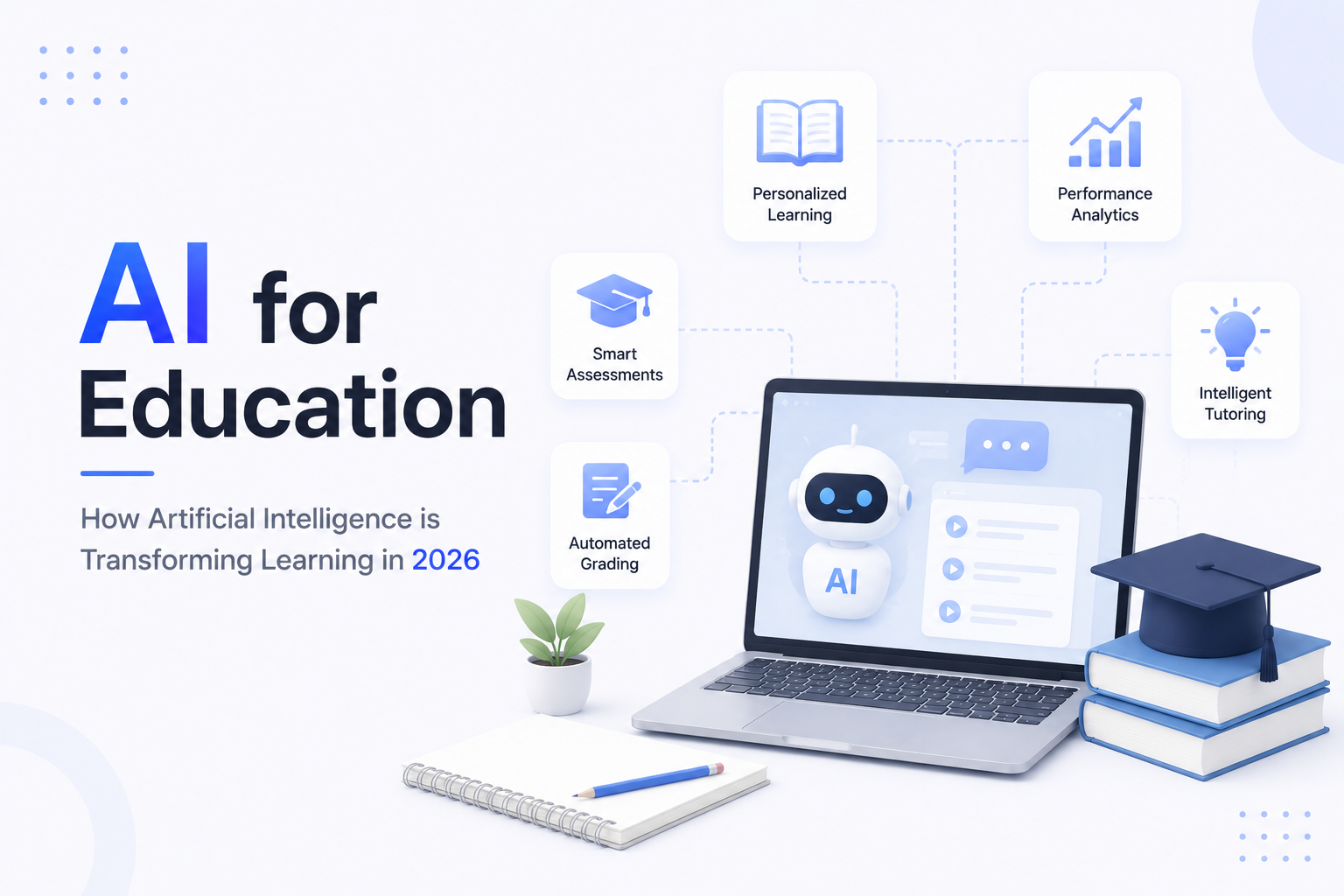
AI for Education: How Artificial Intelligence is Transforming Learning in 2026
Education has always evolved alongside technology. From traditional classrooms to online learning platforms, every innovation has changed how students learn and how educators teach.
Today, Artificial Intelligence is driving the next major transformation.
Schools, universities, coaching institutes, and EdTech companies are using AI to deliver personalized learning experiences, automate administrative work, support teachers, and improve student engagement.
Rather than replacing educators, AI is becoming a powerful assistant that helps teachers focus more on teaching while giving students access to smarter learning tools.
In this guide, we'll explore how AI is transforming education, its practical use cases, benefits, challenges, and what the future of AI-powered learning looks like.
---
Why Education Needs AI
Educational institutions manage thousands of daily activities.
Examples include:
- Student Records
- Assignments
- Examinations
- Attendance
- Course Materials
- Learning Progress
- Admissions
- Administrative Documents
- Student Support
Managing these processes manually takes significant time and resources.
AI helps automate repetitive tasks while improving learning outcomes.
---
What is AI in Education?
AI in education refers to the use of technologies such as Large Language Models (LLMs), Machine Learning, AI Agents, Predictive Analytics, Computer Vision, and Workflow Automation to improve teaching, learning, and educational administration.
AI can:
- Personalize learning
- Answer student questions
- Automate grading
- Generate learning materials
- Track student progress
- Support teachers
- Improve institutional efficiency
AI is designed to assist educators and students—not replace human teaching.
---
Key Benefits of AI in Education
Educational organizations adopting AI gain several advantages.
Personalized Learning
AI adapts lessons based on each student's learning pace, strengths, and areas for improvement.
---
Faster Student Support
AI assistants answer common student questions instantly, even outside school hours.
---
Reduced Administrative Work
Tasks such as attendance tracking, report generation, and document management can be automated.
---
Better Learning Outcomes
Students receive targeted recommendations and additional practice where needed.
---
Increased Teacher Productivity
Teachers spend less time on repetitive administrative tasks and more time supporting students.
---
AI Tutors
One of the biggest applications of AI is intelligent tutoring.
AI tutors can:
- Explain difficult concepts
- Answer questions
- Provide practice exercises
- Recommend learning resources
- Track student progress
- Offer personalized feedback
Students receive additional support whenever they need it.
---
Personalized Learning
Every student learns differently.
AI analyzes:
- Learning Speed
- Quiz Results
- Assignment Performance
- Engagement
- Subject Strengths
- Areas of Difficulty
Based on this information, AI recommends customized learning paths.
This helps students learn more effectively.
---
Automated Grading
Teachers spend considerable time grading assignments and assessments.
AI can assist by:
- Evaluating objective questions
- Providing instant feedback
- Identifying common mistakes
- Organizing grading reports
- Tracking student performance
Educators remain responsible for reviewing subjective assessments and final evaluations.
---
AI Agents for Education
AI Agents are becoming valuable assistants for educational institutions.
They can:
- Answer admission inquiries
- Guide students through enrollment
- Retrieve academic information
- Schedule appointments
- Send reminders
- Support administrative teams
- Help students navigate campus services
This improves communication and operational efficiency.
---
Student Support Chatbots
Educational institutions receive many repetitive questions.
Examples include:
- Admission requirements
- Fee information
- Course schedules
- Examination dates
- Assignment deadlines
- Campus facilities
AI chatbots provide instant responses while directing complex queries to staff when necessary.
---
Content Creation
Teachers and trainers can use AI to generate:
- Lesson Plans
- Quiz Questions
- Study Notes
- Practice Tests
- Presentation Outlines
- Course Summaries
AI speeds up content preparation while allowing educators to customize materials.
---
AI + RAG for Educational Knowledge
Universities and schools maintain extensive documentation.
Using Retrieval-Augmented Generation (RAG), AI can search:
- Course Materials
- Student Handbooks
- Academic Policies
- Research Papers
- Faculty Guidelines
- Learning Resources
Students and faculty receive accurate answers without manually searching large collections of documents.
---
Predictive Analytics
AI helps educational institutions identify students who may need additional support.
It can analyze:
- Attendance Patterns
- Assignment Completion
- Assessment Scores
- Course Engagement
- Learning Progress
These insights help educators intervene early and improve student success.
---
Administrative Automation
Educational institutions can automate:
- Student Registration
- Attendance Management
- Timetable Generation
- Report Cards
- Fee Reminders
- Certificate Processing
- Internal Documentation
Automation reduces manual work and improves institutional efficiency.
---
Real-World Use Cases
Educational organizations use AI for:
Schools
Support teachers and personalize classroom learning.
---
Universities
Improve student services and academic administration.
---
EdTech Companies
Develop AI-powered learning platforms and tutoring systems.
---
Coaching Institutes
Automate student support and create personalized study plans.
---
Corporate Training
Provide intelligent learning assistants and employee development programs.
---
Online Learning Platforms
Deliver adaptive learning experiences and AI-powered course recommendations.
---
Challenges
Implementing AI in education requires thoughtful planning.
Common challenges include:
- Student data privacy
- AI accuracy
- Digital accessibility
- Teacher training
- Infrastructure requirements
- Ethical use of AI
Educational institutions should combine AI with human guidance to ensure meaningful learning experiences.
---
Best Practices
Successful AI adoption includes:
- Protect student data.
- Maintain teacher oversight.
- Use AI to support—not replace—educators.
- Continuously evaluate AI performance.
- Personalize learning responsibly.
- Train staff to use AI effectively.
- Keep educational content updated.
These practices help maximize the value of AI in education.
---
The Future of AI in Education
Artificial Intelligence will continue transforming education.
Future innovations may include:
- AI Learning Assistants
- Voice-Based Tutors
- Virtual Classrooms
- Intelligent Assessment Systems
- Personalized Curriculum Recommendations
- AI Career Guidance
- Multilingual Learning Platforms
Educational institutions that embrace AI will be better prepared to deliver engaging, flexible, and personalized learning experiences.
---
Final Thoughts
Artificial Intelligence is reshaping education by making learning more personalized, improving operational efficiency, and supporting both students and educators.
Rather than replacing teachers, AI empowers them with intelligent tools that reduce administrative work and enhance student engagement.
Schools, universities, and EdTech companies that adopt AI responsibly will be better positioned to prepare learners for the future.
---
Ready to Build AI Solutions for Education?
At WyndrelLabs, we develop enterprise-grade AI solutions for schools, universities, coaching institutes, and EdTech companies.
From AI tutors and intelligent student support assistants to RAG-powered knowledge platforms, workflow automation, personalized learning systems, and AI Agents, we build secure and scalable solutions that improve learning experiences and streamline educational operations.
Book a free consultation today and discover how AI can transform education for your institution or learning platform.