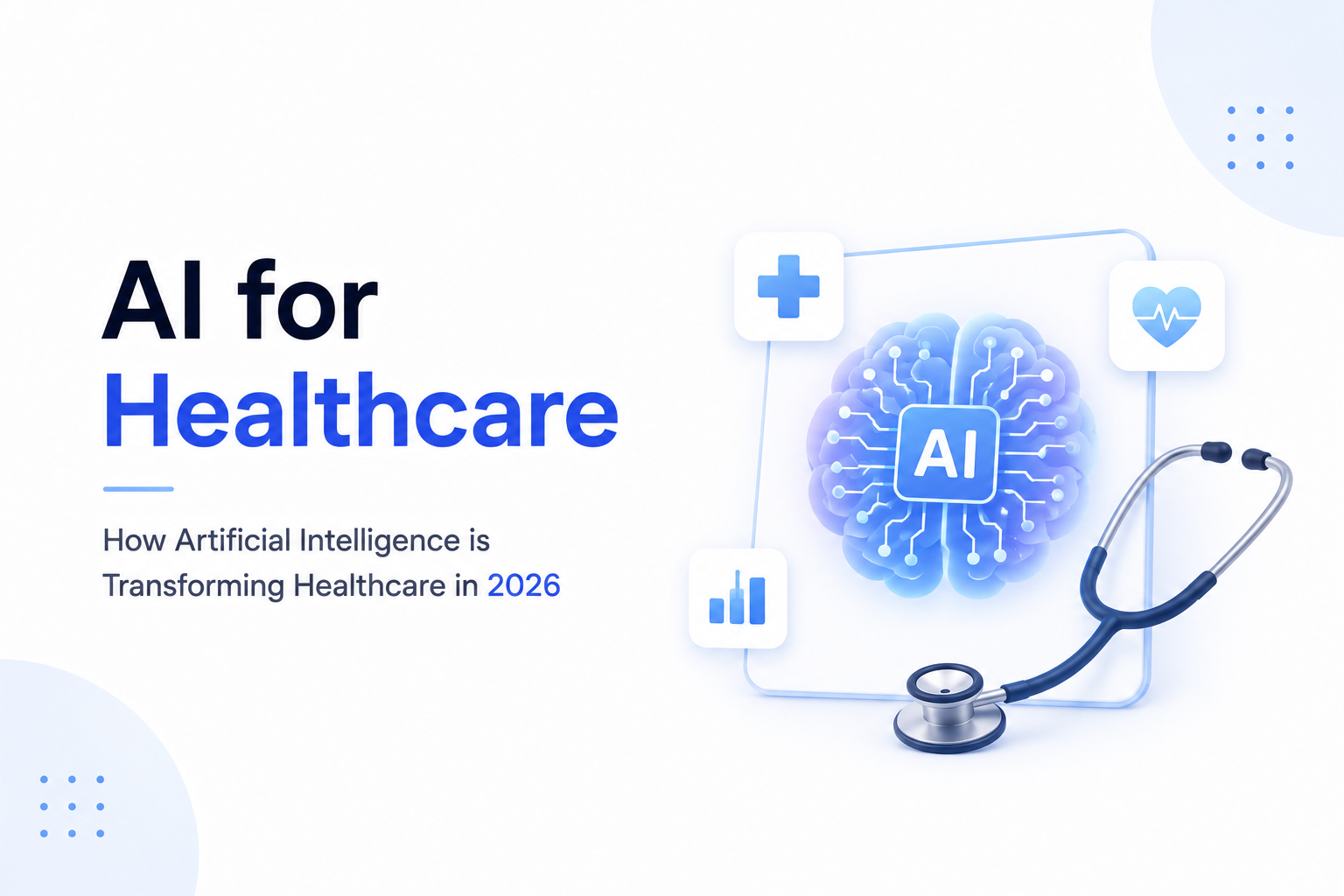
AI for Healthcare: How Artificial Intelligence is Transforming Healthcare in 2026
Healthcare is one of the industries experiencing the biggest transformation through Artificial Intelligence.
Hospitals, clinics, diagnostic laboratories, pharmaceutical companies, and healthcare startups are using AI to improve patient care, automate administrative work, assist doctors in making faster decisions, and reduce operational costs.
From AI-powered medical imaging to intelligent virtual assistants and predictive analytics, AI is helping healthcare professionals deliver better outcomes while saving valuable time.
In this guide, we'll explore how AI is transforming healthcare, its real-world applications, benefits, challenges, and what the future looks like.
---
Why Healthcare Needs AI
Healthcare organizations generate enormous amounts of data every day.
This includes:
- Electronic Health Records (EHR)
- Medical Images
- Laboratory Reports
- Patient Histories
- Prescriptions
- Insurance Documents
- Appointment Data
- Clinical Notes
Managing this information manually is slow and error-prone.
Artificial Intelligence helps healthcare professionals analyze, organize, and use this data more effectively.
---
What is AI in Healthcare?
AI in healthcare refers to the use of machine learning, Large Language Models (LLMs), computer vision, predictive analytics, and AI Agents to improve medical services and hospital operations.
AI systems can:
- Analyze patient records
- Interpret medical images
- Assist with diagnoses
- Automate administrative tasks
- Predict health risks
- Improve patient communication
Importantly, AI is designed to assist healthcare professionals—not replace them.
---
Key Benefits of AI in Healthcare
Healthcare organizations adopting AI experience several advantages.
Faster Diagnosis
AI can analyze medical data quickly, helping clinicians identify patterns and prioritize cases.
---
Reduced Administrative Work
Hospitals spend significant time on scheduling, documentation, billing, and insurance processing.
AI automates many of these repetitive tasks.
---
Better Patient Experience
AI-powered chatbots and virtual assistants answer common questions, schedule appointments, and provide 24/7 support.
---
Improved Decision Support
AI analyzes large volumes of medical data and provides clinicians with evidence-based insights.
---
Cost Savings
Automation reduces operational costs while allowing healthcare professionals to focus on patient care.
---
AI-Powered Medical Imaging
Medical imaging is one of the most successful applications of AI.
AI assists radiologists by analyzing:
- X-rays
- CT Scans
- MRI Scans
- Ultrasounds
- Mammograms
AI highlights areas that may require further review, helping specialists work more efficiently.
The final diagnosis, however, remains the responsibility of qualified medical professionals.
---
AI for Patient Support
Healthcare providers increasingly use AI assistants to improve communication.
Patients can:
- Book appointments
- Receive appointment reminders
- Ask common medical questions
- Access clinic information
- Get prescription reminders
- Receive follow-up instructions
This reduces waiting times and improves patient satisfaction.
---
AI for Hospital Administration
Hospital operations involve thousands of repetitive administrative tasks.
AI can automate:
- Appointment scheduling
- Patient registration
- Billing support
- Insurance verification
- Medical transcription
- Email responses
- Internal workflows
This improves efficiency and reduces manual workload.
---
Predictive Analytics
AI can analyze historical healthcare data to identify potential risks.
Examples include:
- Predicting hospital readmissions
- Identifying high-risk patients
- Forecasting resource demand
- Detecting disease trends
- Supporting preventive care strategies
These insights help healthcare organizations plan more effectively.
---
AI Agents in Healthcare
AI Agents are becoming valuable digital assistants for healthcare teams.
They can:
- Retrieve patient records
- Search medical guidelines
- Summarize clinical documentation
- Route patient inquiries
- Coordinate internal workflows
- Assist administrative staff
When integrated securely with hospital systems, AI Agents can improve productivity without replacing healthcare professionals.
---
AI for Medical Documentation
Clinical documentation consumes a significant amount of physicians' time.
AI can help by:
- Summarizing consultations
- Organizing medical notes
- Drafting documentation
- Extracting structured information
- Preparing reports for review
Doctors remain responsible for verifying and approving medical records.
---
Telemedicine and Virtual Care
Telemedicine continues to expand worldwide.
AI enhances virtual healthcare by providing:
- Intelligent symptom guidance
- Appointment scheduling
- Patient triage assistance
- Follow-up reminders
- Multilingual communication
These capabilities make healthcare services more accessible.
---
Healthcare Data Search with RAG
Hospitals often store thousands of medical protocols and internal documents.
Using Retrieval-Augmented Generation (RAG), AI systems can search:
- Treatment guidelines
- Clinical protocols
- Internal SOPs
- Medical research
- Hospital policies
Healthcare professionals receive relevant information quickly, improving operational efficiency.
---
AI in Drug Research
Pharmaceutical companies are also benefiting from AI.
Applications include:
- Drug discovery
- Clinical trial analysis
- Literature review
- Molecule prediction
- Research data organization
AI accelerates research by processing large datasets more efficiently.
---
Challenges of AI in Healthcare
Despite its benefits, AI implementation requires careful planning.
Common challenges include:
- Protecting patient privacy
- Regulatory compliance
- Data quality
- System integration
- Staff training
- Ethical considerations
Healthcare organizations should implement AI responsibly and maintain human oversight for clinical decisions.
---
Best Practices for Healthcare AI
Successful AI adoption includes:
- Protect patient data.
- Validate AI-generated outputs.
- Maintain clinician oversight.
- Use secure infrastructure.
- Integrate with existing systems.
- Monitor performance continuously.
- Train healthcare staff.
- Comply with local regulations.
These practices help ensure reliable and responsible AI deployment.
---
Real-World Business Use Cases
Healthcare providers are already using AI for:
Hospitals
Improve operational efficiency and patient communication.
---
Clinics
Automate appointment scheduling and patient engagement.
---
Diagnostic Centers
Support imaging workflows and report generation.
---
Telemedicine Platforms
Provide intelligent virtual assistance and patient support.
---
Healthcare Startups
Develop AI-powered health applications and digital services.
---
Insurance Providers
Automate document processing and customer support.
---
The Future of AI in Healthcare
AI will continue to reshape healthcare in the coming years.
Future developments may include:
- More capable AI Agents
- Voice-enabled medical assistants
- Personalized treatment recommendations
- Smarter clinical decision support
- Advanced predictive analytics
- Better integration across healthcare systems
- Multimodal AI combining text, images, and voice
The goal is not to replace healthcare professionals but to give them better tools for delivering high-quality care.
---
Final Thoughts
Artificial Intelligence is becoming an essential technology for modern healthcare organizations.
By automating administrative work, improving access to information, supporting clinical workflows, and enhancing patient experiences, AI helps healthcare providers operate more efficiently while allowing medical professionals to focus on what matters most—patient care.
Organizations that adopt AI thoughtfully and responsibly will be better positioned to meet the growing demands of the healthcare industry.
---
Ready to Bring AI to Your Healthcare Organization?
At WyndrelLabs, we build secure, enterprise-grade AI solutions for hospitals, clinics, healthcare startups, and medical organizations.
From AI-powered patient support assistants and intelligent scheduling systems to RAG-based knowledge platforms, workflow automation, and custom AI Agents, we design scalable solutions that integrate with your existing healthcare operations.
Book a free consultation today and discover how AI can improve patient experiences, streamline operations, and help your healthcare organization innovate with confidence.