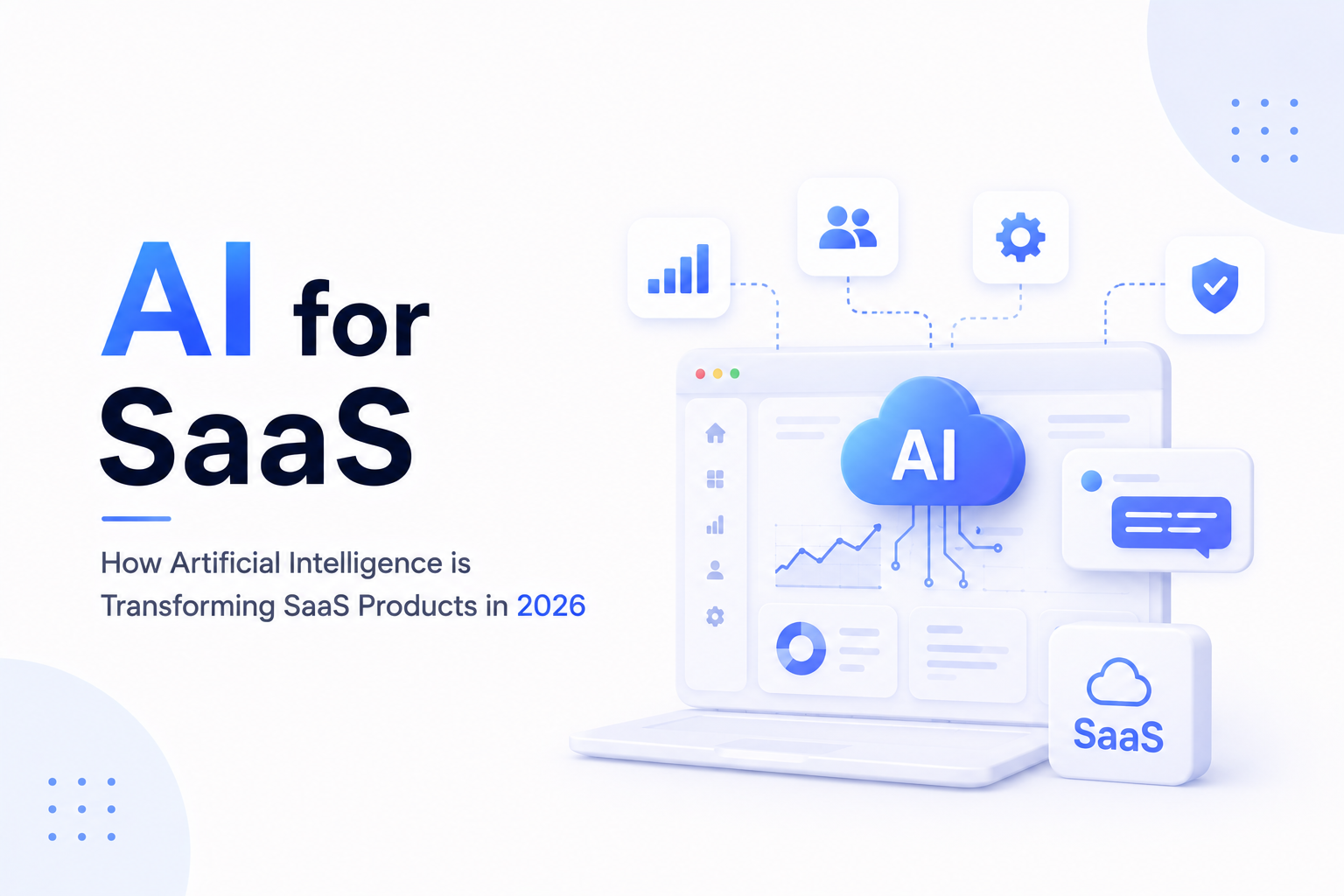
AI for SaaS: How Artificial Intelligence is Transforming SaaS Products in 2026
Software-as-a-Service (SaaS) has transformed how businesses use software, offering scalable cloud-based solutions for organizations of every size. Today, Artificial Intelligence is driving the next wave of innovation by making SaaS products smarter, faster, and more valuable.
Instead of offering static software, modern SaaS companies are integrating AI to automate workflows, personalize user experiences, provide intelligent recommendations, and power AI Agents capable of performing real business tasks.
Whether you're building a CRM, HR platform, project management tool, finance application, or customer support system, AI can significantly increase the value of your product.
In this guide, we'll explore how AI is transforming SaaS businesses, practical use cases, key benefits, implementation strategies, and the future of AI-powered software.
---
Why SaaS Companies Need AI
Modern SaaS users expect software that does more than simply store information.
Customers now expect applications to:
- Automate repetitive tasks
- Generate insights
- Answer questions instantly
- Predict future outcomes
- Personalize experiences
- Reduce manual work
Without AI, SaaS products risk falling behind competitors that provide smarter, more automated experiences.
---
What is AI in SaaS?
AI in SaaS refers to integrating technologies such as Large Language Models (LLMs), Machine Learning, AI Agents, Retrieval-Augmented Generation (RAG), Predictive Analytics, and Workflow Automation into cloud software.
AI can help SaaS platforms:
- Understand user requests
- Generate content
- Analyze data
- Automate business processes
- Recommend actions
- Improve customer support
- Increase user productivity
Rather than replacing existing software, AI enhances its capabilities.
---
Key Benefits of AI for SaaS
Businesses integrating AI into SaaS products gain several advantages.
Better User Experience
AI provides intelligent assistance that helps users complete tasks more efficiently.
---
Increased Customer Retention
Smart features improve product value, encouraging customers to remain subscribed.
---
Higher Productivity
AI automates repetitive workflows, saving users time every day.
---
Competitive Advantage
AI-powered features help SaaS products stand out in crowded markets.
---
Faster Decision Making
AI analyzes large datasets and provides recommendations that support better business decisions.
---
AI Agents Inside SaaS Products
One of the biggest trends in SaaS is embedding AI Agents directly into applications.
AI Agents can:
- Answer customer questions
- Execute workflows
- Search company knowledge
- Generate reports
- Update CRM records
- Schedule meetings
- Create tasks
- Automate repetitive operations
Instead of being passive software, SaaS platforms become active business assistants.
---
AI-Powered Customer Support
Customer support is one of the most common AI use cases.
AI can:
- Answer FAQs
- Resolve common issues
- Route complex tickets
- Summarize conversations
- Suggest solutions to support teams
- Operate 24/7
This improves response times while reducing support costs.
---
Workflow Automation
Many SaaS platforms involve repetitive user actions.
AI automates workflows such as:
- Data entry
- Email generation
- CRM updates
- Task creation
- Meeting scheduling
- Notification management
- Report generation
Users complete more work with fewer manual steps.
---
Intelligent Search with RAG
SaaS products often include large knowledge bases.
Using Retrieval-Augmented Generation (RAG), AI can search:
- Help documentation
- Product manuals
- Internal company knowledge
- User guides
- API documentation
Instead of browsing articles, users simply ask questions in natural language.
---
Personalized User Experience
AI helps SaaS products adapt to individual users.
Examples include:
- Personalized dashboards
- Smart recommendations
- Suggested workflows
- Custom notifications
- Content recommendations
- Predictive insights
Personalization increases engagement and customer satisfaction.
---
AI for Data Analysis
Many SaaS products collect valuable business data.
AI can analyze:
- Customer behavior
- Sales performance
- Product usage
- Financial metrics
- Team productivity
- Operational trends
Instead of reading dashboards manually, users receive actionable insights automatically.
---
AI for Content Generation
Content-driven SaaS products benefit significantly from AI.
Applications include:
- Marketing copy
- Email drafts
- Reports
- Product descriptions
- Meeting summaries
- Documentation
- Knowledge articles
AI reduces the time required to create high-quality content.
---
Predictive Analytics
AI can forecast future outcomes using historical data.
Examples include:
- Customer churn prediction
- Revenue forecasting
- Sales projections
- User engagement analysis
- Subscription renewal likelihood
These insights help businesses make proactive decisions.
---
AI + CRM Integration
Many SaaS platforms integrate with CRM systems.
AI can:
- Qualify leads
- Generate follow-up emails
- Score opportunities
- Summarize customer interactions
- Recommend next actions
Sales teams spend more time selling and less time updating records.
---
Real-World Use Cases
AI is transforming many SaaS categories.
CRM Platforms
Automate sales processes and customer communication.
---
HR Software
Screen resumes, answer employee questions, and automate onboarding.
---
Project Management
Generate tasks, summarize meetings, and monitor project progress.
---
Finance Platforms
Automate reporting, forecasting, and expense analysis.
---
Marketing Software
Generate campaigns, optimize content, and analyze performance.
---
Customer Support Platforms
Provide AI chatbots, ticket summarization, and intelligent routing.
---
Challenges
Implementing AI inside SaaS products requires thoughtful planning.
Common challenges include:
- Data privacy
- Infrastructure costs
- Model selection
- User trust
- Scalability
- AI response quality
- API management
Successful AI products combine automation with human oversight where appropriate.
---
Best Practices
When adding AI to a SaaS product:
- Start with high-impact features.
- Use secure APIs.
- Protect customer data.
- Monitor AI performance.
- Gather user feedback.
- Optimize prompts regularly.
- Integrate AI naturally into existing workflows.
- Continuously improve based on analytics.
These practices help deliver reliable AI experiences.
---
The Future of AI in SaaS
The future of SaaS is increasingly AI-first.
Upcoming trends include:
- AI Co-Pilots
- Autonomous AI Agents
- Voice-enabled SaaS applications
- Multi-Agent collaboration
- Predictive business automation
- Personalized software experiences
- Intelligent workflow orchestration
AI will become a standard feature rather than a competitive advantage.
---
Final Thoughts
Artificial Intelligence is redefining what SaaS products can do.
Instead of acting as passive software, modern SaaS platforms are becoming intelligent assistants that automate work, generate insights, and help users make better decisions.
Companies that successfully integrate AI will deliver more value, improve customer satisfaction, and remain competitive in an increasingly AI-driven software market.
---
Ready to Build an AI-Powered SaaS Product?
At WyndrelLabs, we help startups and enterprises build intelligent SaaS platforms powered by AI.
From AI Agents and RAG-powered knowledge assistants to workflow automation, predictive analytics, and custom AI features, we develop scalable solutions that enhance user experiences and drive business growth.
Whether you're launching a new SaaS product or adding AI to an existing platform, our team can design and build a secure, production-ready solution tailored to your goals.
Book a free consultation today and discover how AI can transform your SaaS business.