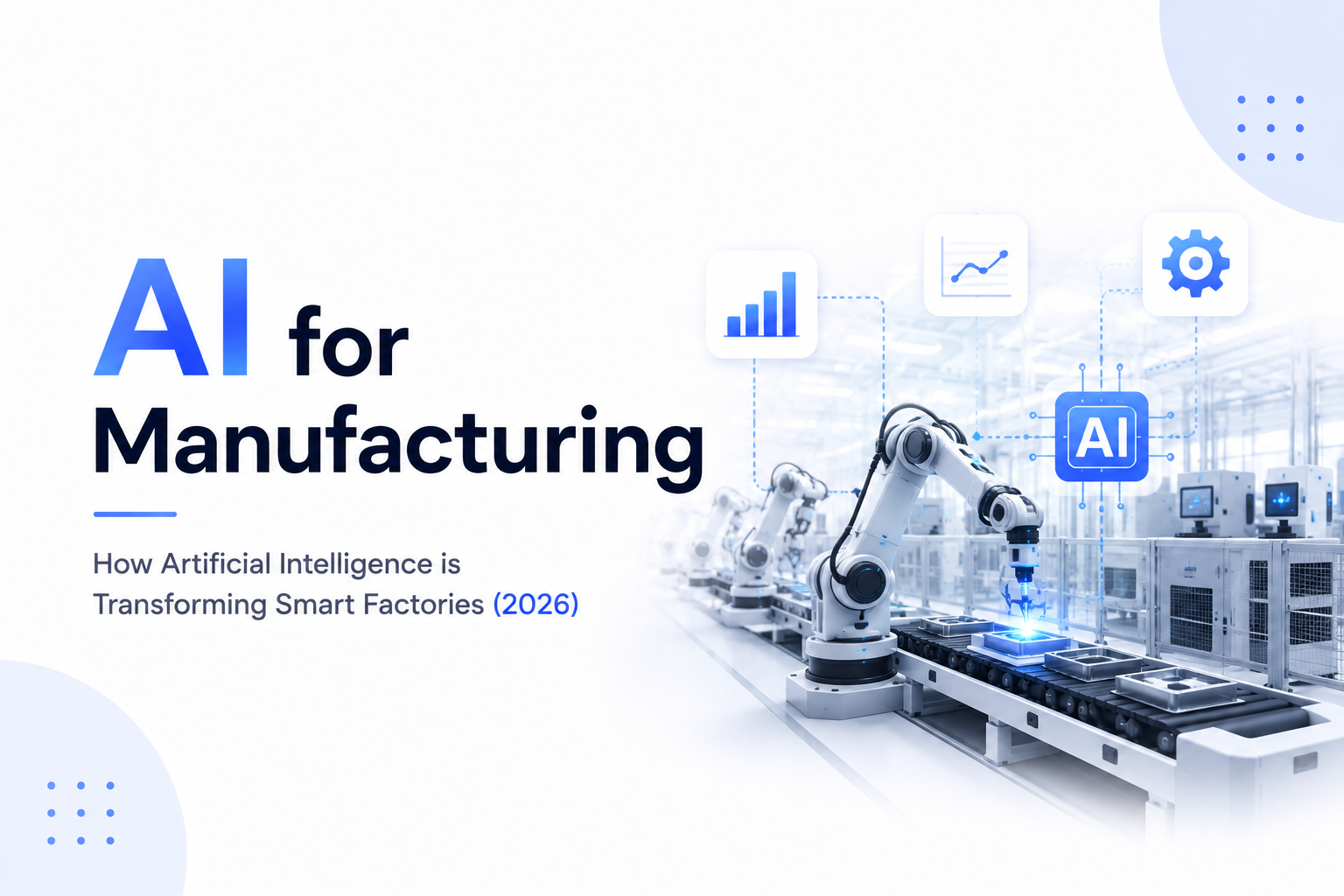
AI for Manufacturing: How Artificial Intelligence is Transforming Smart Factories (2026)
Manufacturing is entering a new era driven by Artificial Intelligence. Modern factories are no longer dependent solely on machines and human operators. AI is helping manufacturers improve production efficiency, reduce downtime, enhance quality control, and make smarter business decisions.
From predictive maintenance and intelligent robotics to AI-powered supply chain management and factory automation, Artificial Intelligence is becoming a core part of Industry 4.0.
In this guide, we'll explore how AI is transforming manufacturing, the most valuable business use cases, key benefits, challenges, and what the future of smart factories looks like.
---
Why Manufacturing Needs AI
Manufacturing companies manage complex operations every day.
These include:
- Production Planning
- Machine Operations
- Inventory Management
- Quality Inspection
- Equipment Maintenance
- Supply Chain Coordination
- Warehouse Operations
- Workforce Scheduling
Managing these processes manually often results in delays, higher costs, equipment failures, and production inefficiencies.
AI helps manufacturers automate routine tasks, analyze operational data, and optimize factory performance.
---
What is AI in Manufacturing?
AI in manufacturing refers to using technologies such as Machine Learning, Computer Vision, AI Agents, Robotics, Large Language Models (LLMs), and Predictive Analytics to improve industrial operations.
AI systems can:
- Monitor equipment
- Detect product defects
- Forecast maintenance
- Optimize production schedules
- Improve inventory management
- Support factory workers
- Analyze operational data
Rather than replacing workers, AI enhances productivity by assisting employees with repetitive and data-intensive tasks.
---
Key Benefits of AI in Manufacturing
Manufacturers adopting AI gain several advantages.
Reduced Downtime
AI predicts equipment failures before they happen, allowing maintenance teams to act early.
---
Improved Product Quality
Computer Vision systems inspect products automatically and identify defects more consistently.
---
Higher Productivity
Automation reduces repetitive work and allows employees to focus on higher-value activities.
---
Lower Operating Costs
AI optimizes production, reduces waste, and improves resource utilization.
---
Better Decision Making
Real-time analytics help managers make faster and more informed production decisions.
---
Predictive Maintenance
Unexpected machine failures can stop an entire production line.
AI continuously monitors equipment using sensor data.
It analyzes:
- Temperature
- Vibration
- Pressure
- Energy Consumption
- Motor Performance
- Operating Hours
When unusual patterns are detected, AI predicts potential failures before they occur.
This allows maintenance teams to schedule repairs proactively instead of reacting to costly breakdowns.
---
AI-Powered Quality Inspection
Traditional quality inspection often relies on manual visual checks.
Computer Vision systems powered by AI inspect products in real time.
Examples include detecting:
- Surface defects
- Cracks
- Incorrect dimensions
- Missing components
- Color inconsistencies
- Packaging issues
This improves product consistency while reducing inspection time.
---
Smart Production Planning
Manufacturing schedules often change due to demand fluctuations, machine availability, or material shortages.
AI helps optimize:
- Production schedules
- Resource allocation
- Workforce planning
- Machine utilization
- Order prioritization
This ensures smoother production and better on-time delivery performance.
---
AI Agents for Manufacturing
AI Agents act as intelligent assistants for factory operations.
They can:
- Monitor production dashboards
- Generate daily reports
- Retrieve machine information
- Answer employee questions
- Coordinate maintenance requests
- Analyze production KPIs
These agents provide valuable operational support without replacing factory staff.
---
Inventory Management
Inventory shortages and overstocking increase operational costs.
AI analyzes:
- Sales Trends
- Production Demand
- Supplier Performance
- Seasonal Variations
- Warehouse Stock Levels
Based on this information, AI recommends optimal inventory levels and purchasing schedules.
---
Supply Chain Optimization
Manufacturers depend on reliable supply chains.
AI improves supply chain management by:
- Forecasting demand
- Identifying supply risks
- Optimizing logistics
- Monitoring supplier performance
- Predicting delivery delays
These insights help businesses maintain stable production.
---
AI for Warehouse Automation
Warehouses benefit significantly from AI-powered automation.
Applications include:
- Smart inventory tracking
- Automated picking
- Barcode recognition
- Route optimization
- Storage recommendations
- Shipment planning
This improves warehouse efficiency while reducing manual effort.
---
AI-Powered Robotics
Modern manufacturing robots use AI to perform repetitive tasks with greater precision.
Examples include:
- Assembly
- Welding
- Painting
- Packaging
- Material Handling
- Machine Loading
AI enables robots to adapt more effectively to changing production environments.
---
AI + RAG for Factory Knowledge
Factories maintain extensive documentation.
Using Retrieval-Augmented Generation (RAG), AI systems can search:
- Equipment Manuals
- Standard Operating Procedures (SOPs)
- Maintenance Guides
- Safety Instructions
- Engineering Documentation
- Quality Standards
Employees receive accurate answers instantly without searching through hundreds of documents.
---
Real-World Use Cases
Manufacturing companies use AI for:
Automotive Manufacturing
Improve production quality and optimize assembly lines.
---
Electronics Manufacturing
Detect microscopic defects and automate inspection.
---
Food & Beverage
Monitor quality, packaging, and production efficiency.
---
Pharmaceutical Manufacturing
Support compliance, documentation, and production monitoring.
---
Heavy Industry
Predict equipment failures and improve maintenance planning.
---
Industrial Equipment Manufacturers
Optimize machine performance and customer support.
---
Challenges
Implementing AI requires careful planning.
Common challenges include:
- Legacy equipment integration
- Data quality
- Employee training
- Infrastructure costs
- Cybersecurity
- System compatibility
Organizations should introduce AI gradually while involving operations teams throughout the process.
---
Best Practices
Successful AI implementation includes:
- Start with high-impact use cases.
- Collect reliable operational data.
- Integrate AI with existing ERP and MES systems.
- Monitor AI performance regularly.
- Maintain human oversight.
- Train employees to work alongside AI.
- Protect industrial data.
These practices improve adoption and long-term success.
---
The Future of AI in Manufacturing
Artificial Intelligence will continue shaping the future of Industry 4.0.
Future innovations include:
- Fully autonomous production lines
- AI-driven digital twins
- Self-optimizing factories
- Intelligent industrial robots
- Predictive supply chains
- AI-powered production planning
- Autonomous quality control
Factories that embrace AI today will be better prepared for tomorrow's competitive manufacturing landscape.
---
Final Thoughts
Artificial Intelligence is becoming a strategic advantage for manufacturers worldwide.
By improving quality control, reducing downtime, optimizing production, and automating repetitive processes, AI helps manufacturers increase efficiency while lowering costs.
The future of manufacturing belongs to organizations that combine skilled workers with intelligent AI-powered systems.
---
Ready to Build AI Solutions for Manufacturing?
At WyndrelLabs, we build enterprise-grade AI solutions for manufacturers, industrial companies, and smart factories.
From predictive maintenance systems and AI-powered quality inspection to workflow automation, RAG-powered knowledge assistants, and intelligent AI Agents, we help manufacturing businesses improve efficiency, reduce costs, and accelerate digital transformation.
Book a free consultation today and discover how AI can power the next generation of smart manufacturing.