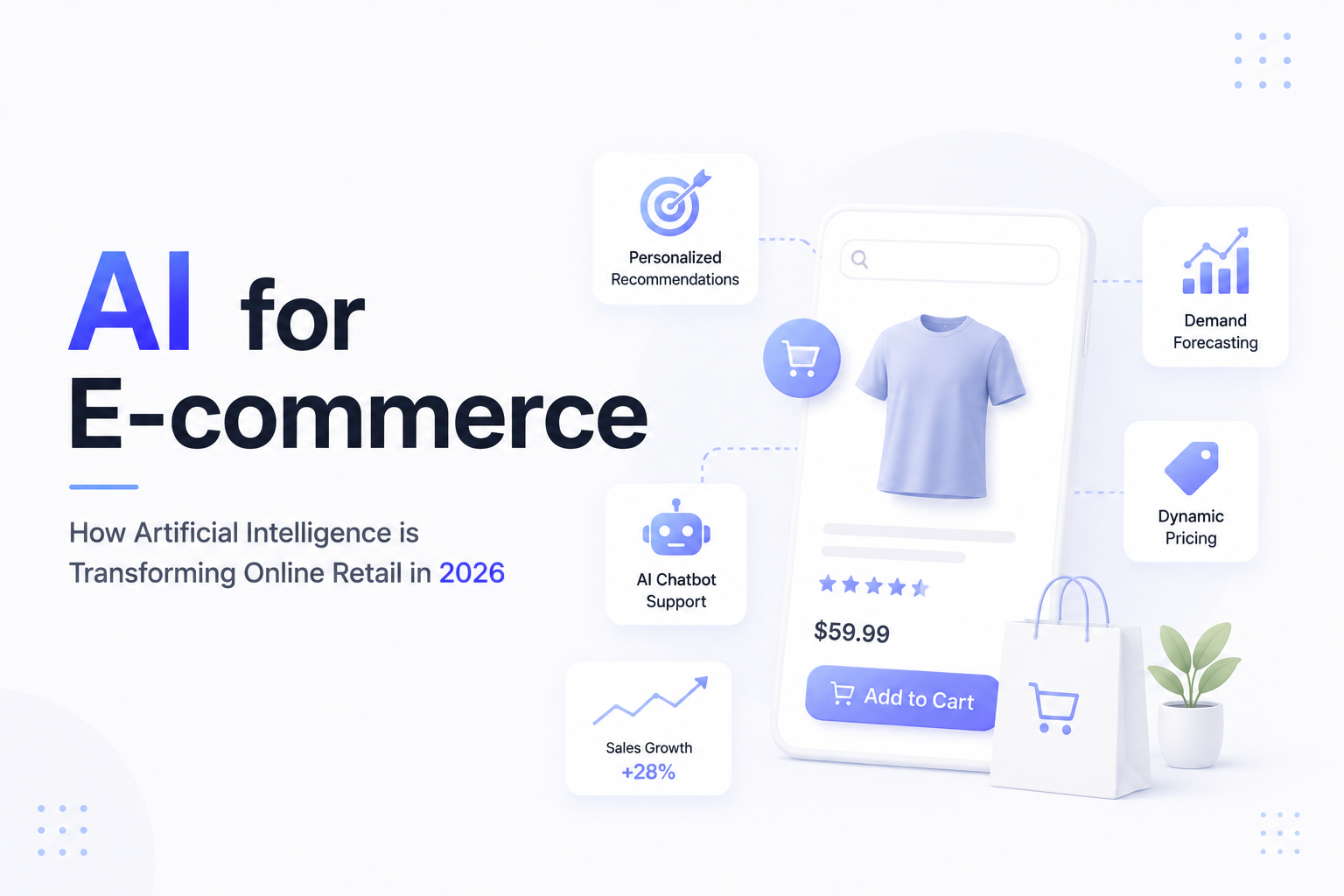
AI for E-commerce: How Artificial Intelligence is Transforming Online Retail in 2026
The e-commerce industry has become one of the most competitive digital markets in the world. Customers expect personalized shopping experiences, instant support, fast deliveries, and accurate product recommendations.
Meeting these expectations manually is becoming increasingly difficult as online stores grow.
Artificial Intelligence is helping e-commerce businesses automate operations, improve customer engagement, optimize inventory, and increase sales.
From AI-powered product recommendations to intelligent customer support and pricing optimization, AI is becoming a key competitive advantage for modern online retailers.
In this guide, we'll explore how AI is transforming e-commerce, its practical business applications, benefits, implementation strategies, and future opportunities.
---
Why E-commerce Needs AI
Online stores manage thousands of daily operations.
Examples include:
- Product Listings
- Customer Support
- Inventory Tracking
- Order Processing
- Marketing Campaigns
- Pricing Updates
- Product Recommendations
- Customer Reviews
- Shipping Operations
Managing these manually reduces efficiency and makes it difficult to deliver personalized experiences.
AI helps automate these repetitive tasks while improving customer satisfaction.
---
What is AI in E-commerce?
AI in e-commerce refers to using technologies such as Large Language Models (LLMs), Machine Learning, AI Agents, Predictive Analytics, Computer Vision, and Workflow Automation to improve online shopping experiences and business operations.
AI can:
- Recommend products
- Personalize shopping experiences
- Answer customer questions
- Forecast inventory demand
- Generate marketing content
- Detect fraud
- Optimize pricing
Rather than replacing online retailers, AI helps them scale more efficiently.
---
Key Benefits of AI for E-commerce
Businesses integrating AI into their online stores gain several advantages.
Personalized Shopping Experience
AI recommends products based on customer interests, browsing history, and purchase behavior.
---
Higher Conversion Rates
Relevant recommendations encourage customers to complete purchases.
---
Faster Customer Support
AI assistants answer customer questions instantly, reducing waiting times.
---
Improved Inventory Management
AI predicts demand and helps businesses maintain optimal stock levels.
---
Better Marketing Performance
AI automates content creation, email campaigns, and customer segmentation.
---
AI-Powered Product Recommendations
Recommendation engines are among the most successful AI applications in e-commerce.
AI analyzes:
- Browsing History
- Purchase History
- Customer Preferences
- Product Categories
- Shopping Behavior
Based on this data, AI suggests products that customers are more likely to purchase.
This increases average order value and improves customer satisfaction.
---
AI Agents for E-commerce
AI Agents can serve as intelligent shopping assistants.
They can:
- Answer product questions
- Recommend products
- Track orders
- Process returns
- Check inventory
- Apply discounts
- Collect customer information
- Assist with checkout
Customers receive immediate assistance without waiting for human support.
---
AI Chatbots for Customer Support
Customer support teams often handle repetitive questions.
Examples include:
- Where is my order?
- What is your return policy?
- Is this item in stock?
- Which size should I buy?
- When will my package arrive?
AI chatbots can answer these questions 24/7 while escalating complex issues to human agents when necessary.
---
Inventory Management
Maintaining the right inventory levels is critical.
AI analyzes:
- Historical Sales
- Seasonal Trends
- Customer Demand
- Supplier Performance
- Product Popularity
Businesses receive inventory recommendations that help reduce stock shortages and excess inventory.
---
Dynamic Pricing
AI can optimize product pricing based on:
- Market Demand
- Competitor Pricing
- Inventory Levels
- Seasonal Sales
- Customer Behavior
Businesses can make informed pricing decisions while maintaining competitiveness.
---
Marketing Automation
AI helps online retailers automate marketing activities.
Applications include:
- Email Campaigns
- Product Descriptions
- Advertisement Copy
- Social Media Posts
- Customer Segmentation
- Promotional Campaigns
Marketing teams can create personalized campaigns at scale.
---
AI + RAG for Product Knowledge
Large online stores often have extensive product catalogs and documentation.
Using Retrieval-Augmented Generation (RAG), AI can search:
- Product Manuals
- FAQs
- Warranty Information
- Shipping Policies
- Return Policies
- Internal Documentation
Customers receive accurate, context-aware answers without browsing multiple pages.
---
AI for Fraud Detection
Online retailers face risks such as payment fraud and account misuse.
AI helps identify:
- Suspicious Transactions
- Unusual Purchase Patterns
- Fake Accounts
- Chargeback Risks
- Account Takeovers
Fraud detection systems support security while reducing unnecessary manual reviews.
---
AI for Customer Insights
AI analyzes customer behavior to provide valuable business insights.
Examples include:
- Purchase Trends
- Customer Lifetime Value
- Churn Prediction
- Product Performance
- Campaign Effectiveness
- Shopping Preferences
These insights help businesses improve marketing and product strategies.
---
Real-World Use Cases
E-commerce businesses use AI for:
Online Retail Stores
Deliver personalized shopping experiences.
---
D2C Brands
Improve customer engagement and automate marketing.
---
Marketplace Platforms
Recommend products and optimize search results.
---
Fashion Retailers
Provide size recommendations and personalized suggestions.
---
Electronics Stores
Offer intelligent product comparisons and support.
---
Grocery Platforms
Forecast demand and optimize inventory.
---
Challenges
Implementing AI in e-commerce requires careful planning.
Common challenges include:
- Data privacy
- Product data quality
- Integration with existing platforms
- Customer trust
- AI accuracy
- Infrastructure costs
Businesses should deploy AI gradually while monitoring performance and customer feedback.
---
Best Practices
Successful AI implementation includes:
- Keep product information updated.
- Integrate AI with CRM and inventory systems.
- Protect customer data.
- Monitor AI-generated recommendations.
- Test AI features regularly.
- Personalize experiences responsibly.
- Combine AI automation with human support where appropriate.
These practices improve reliability and customer satisfaction.
---
The Future of AI in E-commerce
Artificial Intelligence will continue reshaping online retail.
Future innovations include:
- AI Shopping Assistants
- Voice Commerce
- Visual Product Search
- Autonomous Customer Support
- Hyper-Personalized Recommendations
- Predictive Inventory Management
- AI-Powered Checkout Experiences
Retailers that embrace AI will deliver faster, smarter, and more personalized shopping experiences.
---
Final Thoughts
Artificial Intelligence is becoming a core technology for modern e-commerce businesses.
By improving personalization, automating operations, optimizing inventory, and enhancing customer support, AI enables online retailers to scale more efficiently while delivering better customer experiences.
Businesses that integrate AI thoughtfully will be better positioned to compete in the rapidly evolving world of digital commerce.
---
Ready to Build AI Solutions for Your E-commerce Business?
At WyndrelLabs, we build enterprise-grade AI solutions for online retailers, D2C brands, marketplaces, and e-commerce startups.
From AI shopping assistants and intelligent product recommendations to RAG-powered product search, customer support automation, inventory optimization, and AI Agents, we design scalable solutions that help businesses increase sales, improve customer experiences, and streamline operations.
Book a free consultation today and discover how AI can transform your e-commerce business.