What is RAG? A Complete Beginner's Guide to Retrieval-Augmented Generation (2026)
Artificial Intelligence has become incredibly powerful, but even the best Large Language Models (LLMs) have one major limitation—they don't always know your business data.
Ask ChatGPT about a public topic, and it usually performs well.
Ask it questions about your company's private documents, customer contracts, product manuals, internal knowledge base, or policies, and it cannot answer accurately unless that information is provided.
This is where Retrieval-Augmented Generation (RAG) comes in.
RAG allows AI models to retrieve relevant information from your own data before generating an answer. Instead of relying only on what the model learned during training, it combines external knowledge with the reasoning abilities of an LLM.
The result is more accurate, up-to-date, and context-aware AI responses.
In this guide, you'll learn what RAG is, how it works, why businesses are adopting it, and how you can build your own RAG-powered AI applications.
---
What is RAG?
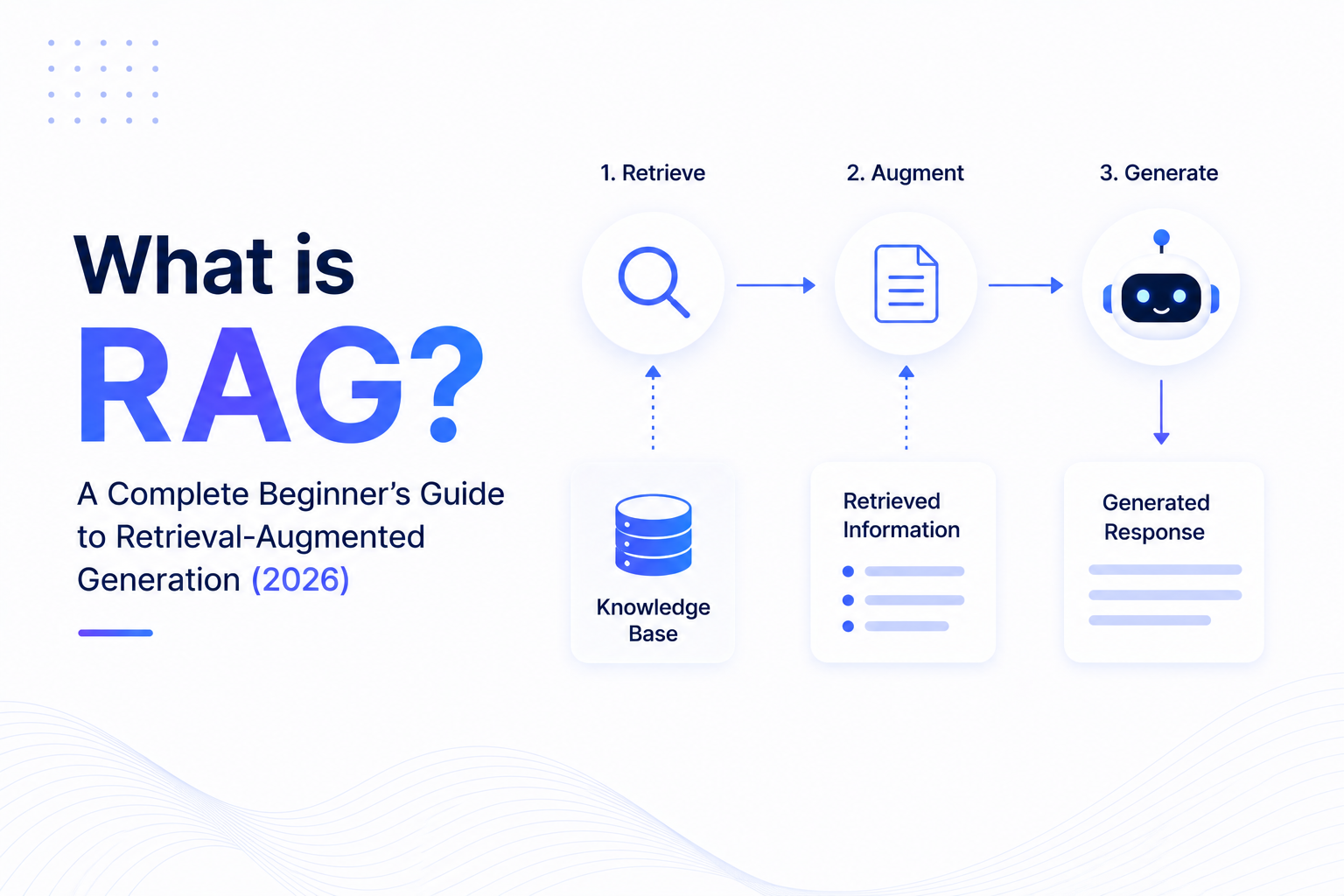
Retrieval-Augmented Generation (RAG) is an AI architecture that combines two powerful capabilities:
- Information Retrieval – Finding relevant information from external data sources.
- Text Generation – Using a Large Language Model (LLM) to generate natural language responses.
Instead of asking an LLM to answer entirely from memory, RAG first searches a knowledge base, retrieves the most relevant information, and then uses that information to generate an accurate answer.
Think of it as giving an AI assistant access to your company's documents before it responds.
---
Why Do We Need RAG?
Large Language Models have several limitations.
They:
- Cannot access your private documents by default.
- May generate outdated information.
- Can hallucinate (confidently provide incorrect answers).
- Don't automatically know newly created content.
- Have limited context windows.
Businesses need AI systems that answer questions using their own data rather than relying solely on general internet knowledge.
RAG solves this problem.
---
How Does RAG Work?
A typical RAG workflow looks like this:
User asks a question
↓
The question is converted into an embedding
↓
A vector database searches for similar documents
↓
Relevant documents are retrieved
↓
The retrieved information is added to the prompt
↓
The LLM generates an answer
↓
The user receives a response based on company knowledge
Instead of guessing, the AI answers using verified information from your own data.
---
Example Without RAG
Imagine a customer asks:
"What is your refund policy?"
A standard LLM may:
- Guess the answer
- Provide a generic refund policy
- Hallucinate information
- Return outdated content
This creates a poor customer experience.
---
Example With RAG
Now imagine the same question using RAG.
The AI:
- Searches your knowledge base
- Finds your official refund policy
- Sends that policy to the LLM
- Generates a response using the retrieved document
The answer is accurate, current, and specific to your business.
---
Components of a RAG System
Every RAG application consists of several key components.
---
1. Data Source
This is where your business information lives.
Examples include:
- PDFs
- Word documents
- Company wikis
- Notion pages
- Google Drive
- Product manuals
- FAQs
- CRM data
- Databases
- Websites
---
2. Document Processing
Documents are cleaned and divided into smaller chunks.
Instead of storing an entire 100-page PDF, the system stores smaller sections that are easier to retrieve.
This process is called chunking.
---
3. Embeddings
The text chunks are converted into numerical vectors called embeddings.
Embeddings represent the meaning of text rather than exact words.
This allows AI to understand semantic similarity.
---
4. Vector Database
Embeddings are stored inside a vector database such as:
- Pinecone
- ChromaDB
- Weaviate
- Qdrant
- Milvus
These databases can quickly find documents that are most similar to a user's question.
---
5. Retriever
The retriever searches the vector database.
Instead of matching keywords, it searches by meaning.
Only the most relevant document chunks are selected.
---
6. Large Language Model
Finally, the retrieved information is sent to an LLM like:
- GPT-4
- Claude
- Gemini
- Llama
- Mistral
The LLM generates an answer using the retrieved context.
---
Benefits of RAG
Businesses are adopting RAG because it solves many common AI challenges.
More Accurate Responses
The AI answers using trusted business information instead of guessing.
---
Up-to-Date Knowledge
Simply update your documents.
There's no need to retrain the language model every time information changes.
---
Reduced Hallucinations
Since the model receives factual context before answering, incorrect responses become much less common.
---
Data Privacy
Your knowledge remains under your control.
Many RAG systems can run using private infrastructure and secure vector databases.
---
Lower Costs
Updating documents is significantly cheaper than training a custom AI model.
---
Real-World Use Cases
RAG is already being used across many industries.
Customer Support
AI answers questions using product manuals, FAQs, and company documentation.
---
Internal Knowledge Assistant
Employees can instantly search company policies, SOPs, and technical documentation.
---
Healthcare
Doctors can search medical guidelines and hospital protocols.
---
Legal
Law firms can retrieve contracts, regulations, and case documents.
---
Finance
Banks use RAG to answer questions about internal compliance policies and financial procedures.
---
E-commerce
AI helps customers find product information, shipping details, warranty policies, and return instructions.
---
RAG vs Fine-Tuning
Many beginners confuse RAG with fine-tuning.
They solve different problems.
| RAG | Fine-Tuning |
|---|---|
| Uses external documents | Changes the model itself |
| Easy to update | Expensive to retrain |
| Lower cost | Higher cost |
| Best for business knowledge | Best for changing model behavior |
| Fast deployment | Longer development cycle |
For most businesses, RAG is the preferred solution because it keeps knowledge current without retraining the AI model.
---
Common Technologies Used
Modern RAG systems are built using:
- LangChain
- LangGraph
- LlamaIndex
- OpenAI
- Claude
- Gemini
- Pinecone
- ChromaDB
- Qdrant
- FastAPI
- Python
- Node.js
These tools simplify building production-ready RAG applications.
---
Challenges of RAG
Although RAG is powerful, developers should be aware of common challenges.
These include:
- Poor document chunking
- Low-quality embeddings
- Incorrect retrieval results
- Outdated knowledge sources
- Slow search performance
- Weak prompt design
A successful RAG system depends on high-quality data and proper implementation.
---
Best Practices
When building a RAG application:
- Keep documents updated.
- Use meaningful chunk sizes.
- Select a reliable embedding model.
- Choose an appropriate vector database.
- Retrieve only the most relevant results.
- Test prompts regularly.
- Monitor answer quality.
- Add citations whenever possible.
Following these practices improves both accuracy and user trust.
---
The Future of RAG
Retrieval-Augmented Generation is becoming the standard architecture for enterprise AI.
Future RAG systems will:
- Search multiple knowledge sources simultaneously.
- Integrate with business applications.
- Support multimodal data such as images and videos.
- Work alongside AI Agents.
- Perform autonomous reasoning before responding.
As businesses continue adopting AI, RAG will remain one of the most important technologies for building trustworthy and scalable AI assistants.
---
Final Thoughts
Large Language Models are powerful, but they become significantly more useful when connected to your own business knowledge.
Retrieval-Augmented Generation allows organizations to build AI systems that provide accurate, reliable, and up-to-date answers using internal documents and data.
Whether you're creating a customer support chatbot, an internal knowledge assistant, or an enterprise AI Agent, RAG provides the foundation for intelligent, context-aware applications.
---
Ready to Build a RAG-Powered AI Solution?
At WyndrelLabs, we design and develop enterprise-grade RAG systems that connect Large Language Models with your business knowledge.
From intelligent customer support assistants and internal knowledge bases to AI Agents powered by vector databases and secure document retrieval, we build scalable solutions tailored to your organization.
Book a free consultation today and discover how Retrieval-Augmented Generation can transform the way your business uses AI.