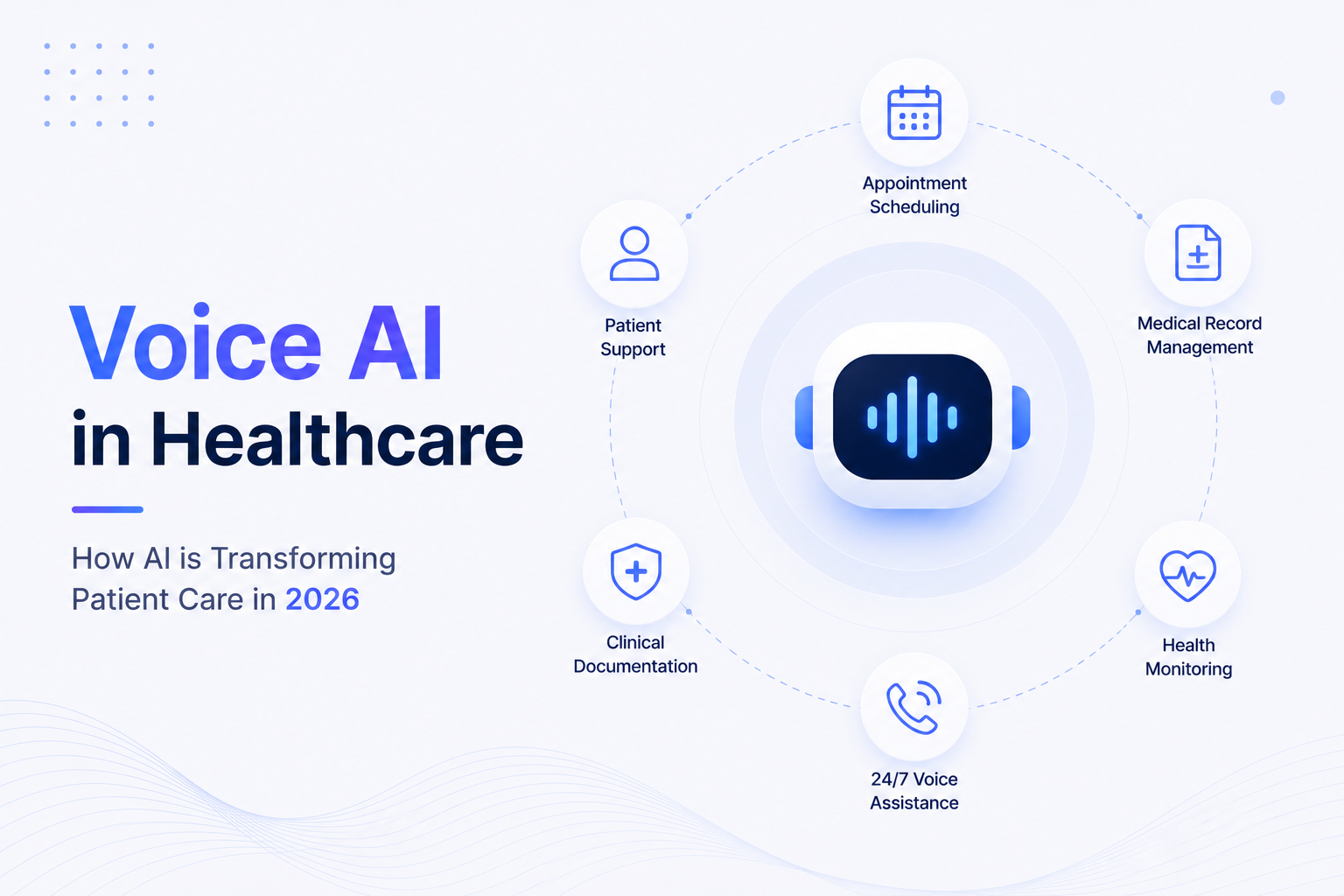
Voice AI in Healthcare: How AI is Transforming Patient Care in 2026
Healthcare is one of the industries experiencing the greatest impact from Artificial Intelligence. Hospitals, clinics, diagnostic centers, and telemedicine providers handle thousands of patient interactions every day, ranging from appointment bookings and follow-up calls to prescription reminders and administrative support.
Managing these interactions manually requires significant time, staff, and operational resources.
Voice AI is changing this by enabling healthcare organizations to automate conversations while maintaining a natural, human-like patient experience.
Instead of waiting on hold or navigating complicated phone menus, patients can speak naturally with an AI assistant that understands their needs, accesses medical systems, and performs tasks automatically.
In this guide, we'll explore how Voice AI is transforming healthcare, its practical use cases, benefits, challenges, and what the future holds for AI-powered patient communication.
---
What is Voice AI in Healthcare?
Voice AI in healthcare refers to intelligent voice assistants that use Speech-to-Text (STT), Large Language Models (LLMs), and Text-to-Speech (TTS) technology to communicate with patients.
Unlike traditional IVR systems, Voice AI understands natural language and can respond conversationally.
It can:
- Book appointments
- Answer patient questions
- Send medication reminders
- Collect patient information
- Verify insurance details
- Route urgent cases
- Assist hospital staff
Voice AI acts as a digital healthcare assistant available around the clock.
---
Why Healthcare Needs Voice AI
Healthcare providers face several operational challenges:
- Long call queues
- Staff shortages
- Administrative overload
- Missed appointments
- High patient volumes
- Limited support outside working hours
Many patient calls involve repetitive requests that do not require a healthcare professional.
Examples include:
- Appointment booking
- Clinic timings
- Prescription refill requests
- Test report availability
- Insurance questions
- General information
Voice AI automates these repetitive interactions, allowing doctors and medical staff to focus on patient care.
---
How Voice AI Works in Healthcare
A typical healthcare Voice AI workflow looks like this:
Patient Calls
↓
Speech-to-Text converts spoken words into text.
↓
AI understands the patient's request.
↓
Hospital Management System is queried.
↓
Required action is completed.
↓
Voice response is generated.
↓
Patient receives confirmation.
Everything happens in real time without requiring human intervention for routine requests.
---
Use Case 1: Appointment Scheduling
Appointment booking is one of the most common healthcare tasks.
Voice AI can:
- Check doctor availability
- Suggest appointment slots
- Confirm bookings
- Reschedule appointments
- Cancel visits
- Send reminders
Patients receive immediate assistance without waiting for reception staff.
---
Use Case 2: Medication Reminders
Patients often forget to take medicines or miss follow-up appointments.
Voice AI can automatically:
- Call patients
- Remind them about medications
- Confirm dosage schedules
- Send follow-up reminders
- Notify caregivers if required
This improves treatment adherence.
---
Use Case 3: AI Medical Receptionist
Instead of hiring additional front desk staff, hospitals can deploy an AI Receptionist.
It can:
- Answer incoming calls
- Provide clinic information
- Direct patients to departments
- Book appointments
- Collect patient details
- Handle after-hours calls
The reception remains available 24/7.
---
Use Case 4: Patient Follow-Up
After treatment or surgery, hospitals often need to check on patients.
Voice AI can automatically:
- Ask recovery-related questions
- Collect feedback
- Identify warning symptoms
- Notify healthcare staff if intervention is needed
Routine follow-ups become more consistent and scalable.
---
Use Case 5: Insurance Verification
Patients frequently call regarding insurance coverage.
Voice AI can:
- Verify insurance eligibility
- Explain covered services
- Collect required information
- Route complex cases to billing specialists
Administrative work is reduced significantly.
---
Use Case 6: Clinical Documentation
Doctors spend a large portion of their day documenting consultations.
Voice AI can:
- Transcribe conversations
- Generate consultation summaries
- Create structured medical notes
- Assist with electronic health records (EHR)
This reduces paperwork and allows physicians to spend more time with patients.
---
Benefits of Voice AI in Healthcare
24/7 Patient Support
Patients receive assistance at any time, even outside hospital working hours.
---
Reduced Administrative Work
Routine phone calls no longer require human staff.
Receptionists can focus on complex patient interactions.
---
Shorter Waiting Times
Patients receive instant responses instead of waiting in long call queues.
---
Better Patient Experience
Natural conversations create a more convenient and personalized experience.
---
Improved Efficiency
Healthcare professionals spend more time providing care instead of handling repetitive administrative tasks.
---
Cost Savings
Hospitals can reduce operational costs while handling more patient interactions.
---
Voice AI vs Traditional Hospital IVR
| Feature | Traditional IVR | Voice AI |
|---|---|---|
| Natural Conversation | ❌ No | ✅ Yes |
| Appointment Booking | Limited | ✅ Automatic |
| Understands Context | ❌ No | ✅ Yes |
| Works 24/7 | ✅ Yes | ✅ Yes |
| Patient Satisfaction | Moderate | High |
| CRM / EHR Integration | Limited | Advanced |
| Handles Multiple Calls | Limited | Unlimited |
Voice AI provides a much smoother experience compared to menu-driven IVR systems.
---
Technologies Behind Healthcare Voice AI
Modern healthcare Voice AI combines:
- Speech-to-Text (STT)
- Text-to-Speech (TTS)
- Large Language Models (LLMs)
- Electronic Health Record (EHR) systems
- Hospital Management Software (HMS)
- Appointment Scheduling APIs
- Workflow Automation
- CRM Integration
Together, these technologies create intelligent healthcare assistants capable of performing real operational tasks.
---
Challenges and Considerations
Healthcare organizations must implement Voice AI responsibly.
Important considerations include:
- Patient privacy
- Secure handling of medical data
- Compliance with healthcare regulations
- Human oversight for critical cases
- Clear escalation paths to medical staff
- Continuous monitoring and testing
Voice AI should support healthcare professionals—not replace clinical decision-making.
---
The Future of Voice AI in Healthcare
Voice AI is expected to become a standard component of modern healthcare.
Future systems will:
- Understand patient history
- Support multiple languages
- Detect emotional cues
- Integrate with wearable health devices
- Provide personalized health guidance
- Work alongside AI medical agents
Hospitals will increasingly rely on Voice AI to improve patient engagement and operational efficiency.
---
Final Thoughts
Healthcare organizations are under constant pressure to improve patient care while managing growing administrative workloads.
Voice AI provides a practical solution by automating repetitive interactions, improving accessibility, reducing costs, and enabling healthcare professionals to focus on what matters most—delivering quality patient care.
As AI technology continues to advance, Voice AI will become an essential part of every modern healthcare organization.
---
Ready to Build a Healthcare Voice AI Solution?
At WyndrelLabs, we develop secure, enterprise-grade Voice AI solutions for hospitals, clinics, diagnostic centers, and healthcare providers.
Our Voice AI systems can automate appointment booking, patient support, follow-up calls, medical reception, and healthcare workflows while integrating seamlessly with your existing software.
Whether you're building an AI Receptionist, a virtual patient assistant, or a complete Voice AI platform, we can help you create a scalable and reliable solution tailored to your healthcare organization.
Book a free consultation today and discover how Voice AI can transform your healthcare operations.