Embeddings Explained Simply: The Foundation of Modern AI Applications (2026)
If you've started learning about AI, you've probably heard terms like Embeddings, Vector Databases, Semantic Search, and RAG (Retrieval-Augmented Generation).
At first, these concepts can seem confusing.
But here's the good news:
Embeddings are actually one of the simplest—and most important—concepts behind modern AI.
Without embeddings, AI assistants like ChatGPT couldn't understand meaning, AI chatbots couldn't search company documents, recommendation systems wouldn't work, and Retrieval-Augmented Generation (RAG) wouldn't exist.
In this guide, we'll explain embeddings in the simplest possible way, explore how they work, and understand why they are the foundation of modern AI applications.
---
What Are Embeddings?
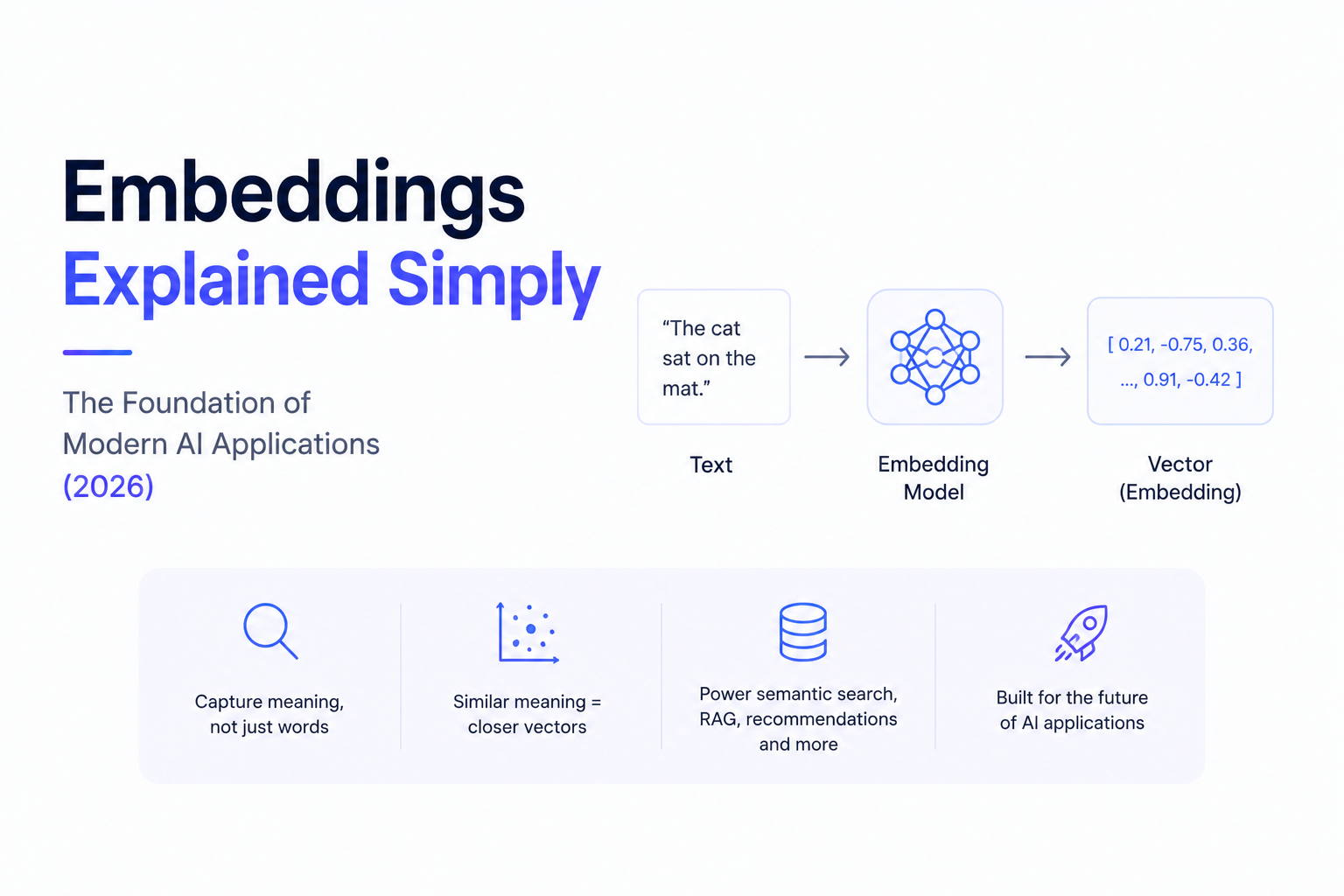
An embedding is a numerical representation of information.
Instead of storing words as plain text, AI converts them into a list of numbers that represents their meaning.
For example:
Artificial Intelligence

↓

[0.28, -0.41, 0.83, 0.15, ...]
These numbers may not make sense to humans, but they allow computers to understand relationships between words and concepts.
Embeddings transform language into mathematics.
---
Why Do We Need Embeddings?
Computers cannot naturally understand human language.
For a computer, these two sentences are completely different:
"I want a refund."
"I want my money back."
Humans know they mean the same thing.
Traditional software does not.
Embeddings solve this problem.
They represent both sentences with vectors that are very close together, allowing AI to understand that they express the same intent.
---
A Simple Analogy
Imagine a world map.
Cities that are geographically close appear near each other.
Delhi and Noida are close.
Delhi and New York are far apart.
Embeddings work the same way.
Instead of placing cities on a map, they place ideas in a mathematical space.
Concepts with similar meanings are located close together.
Completely different concepts are far apart.
---
How Embeddings Are Created
Embeddings are generated using specialized AI models.
The process looks like this:
Text
↓
Embedding Model
↓
Mathematical Vector
↓
Stored in Vector Database
Every document, paragraph, sentence, image, or query can be converted into an embedding.
---
What is an Embedding Model?
An embedding model is a machine learning model trained to convert information into vectors while preserving semantic meaning.
Popular embedding models include:
- OpenAI Embeddings
- Gemini Embeddings
- Voyage AI
- Cohere Embed
- BAAI BGE
- E5 Models
- Sentence Transformers
Each model generates vectors with different dimensions and optimizations.
---
Understanding Semantic Similarity
Consider these examples:
Sentence A
"How do I return a product?"
Sentence B
"I want a refund."
Sentence C
"What is the weather today?"
Embeddings place Sentence A and Sentence B close together because they are about product returns.
Sentence C is placed much farther away because it discusses weather.
This is called semantic similarity.
AI searches by meaning instead of exact words.
---
Where Are Embeddings Used?
Embeddings power many modern AI applications.
---
Retrieval-Augmented Generation (RAG)
Business documents are converted into embeddings and stored inside a Vector Database.
When a user asks a question, AI retrieves the most relevant documents using embeddings before generating a response.
This enables accurate, context-aware answers.
---
AI Chatbots
Instead of memorizing every document, chatbots search embeddings to retrieve relevant information before answering.
---
Recommendation Systems
Streaming platforms and e-commerce websites recommend content by comparing embeddings.
If two movies or products have similar embeddings, they are likely to be recommended together.
---
Semantic Search
Instead of matching keywords, search engines compare embeddings to find information with similar meaning.
---
Image Search
Images are converted into embeddings.
Searching for "red sports car" retrieves visually similar images even if filenames don't contain those words.
---
Voice AI
Voice conversations are converted into text, embedded, and searched against company knowledge bases before generating intelligent responses.
---
Embeddings and Vector Databases
Embeddings alone are not enough.
They must be stored somewhere.
That's where Vector Databases come in.
The workflow looks like this:
Documents
↓
Embedding Model
↓
Embeddings
↓
Vector Database
↓
User Query
↓
Embedding Generated
↓
Similarity Search
↓
Relevant Results Returned
This architecture powers nearly every production RAG system.
---
Embeddings vs Keywords
Traditional Search
Looks for exact words.
Example:
Search:
"Refund"
Finds:
"Refund Policy"
May miss:
"Money Back Guarantee"
---
Embedding Search
Searches by meaning.
A query about refunds can also retrieve:
- Returns
- Exchanges
- Cancellations
- Product Replacement
This makes AI search significantly more intelligent.
---
Real-World Example
Imagine a company has thousands of PDF documents.
An employee asks:
"How do I request work from home?"
The actual policy document is titled:
"Remote Work Guidelines"
Traditional keyword search may fail.
Embedding search understands that:
- Work from Home
- Remote Work
- Hybrid Work
are related concepts.
It retrieves the correct document instantly.
---
Benefits of Embeddings
Organizations using embeddings gain several advantages.
Better Search Accuracy
Results are based on meaning rather than exact wording.
---
Faster AI Responses
Relevant information is retrieved within milliseconds.
---
Improved Customer Experience
Customers receive more accurate answers.
---
Smarter AI Assistants
AI understands context instead of relying only on keywords.
---
Enterprise Knowledge Search
Employees can ask natural questions without knowing exact document titles.
---
Challenges
Although embeddings are powerful, developers should consider:
- Choosing the right embedding model
- Updating embeddings when documents change
- Optimizing chunk size
- Managing storage efficiently
- Measuring search quality
- Handling multilingual data
Good embeddings are critical for successful RAG systems.
---
Best Practices
When using embeddings:
- Use high-quality embedding models.
- Keep knowledge up to date.
- Chunk documents appropriately.
- Store useful metadata.
- Test retrieval accuracy regularly.
- Remove duplicate content.
- Combine embeddings with Vector Databases.
These practices improve search quality and AI responses.
---
The Future of Embeddings
Embeddings are becoming the universal language of AI.
Future embedding models will support:
- Text
- Images
- Audio
- Video
- Documents
- Source Code
- 3D Objects
This will enable truly multimodal AI systems capable of understanding information across multiple formats.
Embeddings will continue to serve as the foundation of semantic search, AI Agents, recommendation engines, and enterprise knowledge systems.
---
Final Thoughts
Embeddings may seem like a technical concept, but they solve one simple problem:
Helping computers understand meaning instead of just words.
From AI chatbots and recommendation engines to enterprise search and Retrieval-Augmented Generation, embeddings are the foundation that makes modern AI applications intelligent.
If you're learning AI, understanding embeddings is one of the most valuable investments you can make.
---
Ready to Build AI Applications with Embeddings?
At WyndrelLabs, we build AI-powered solutions that use embeddings, Vector Databases, and Retrieval-Augmented Generation to create intelligent search systems, AI chatbots, enterprise knowledge assistants, and AI Agents.
Whether you're building an internal knowledge base or a customer-facing AI assistant, our team can design scalable AI architectures tailored to your business.
Book a free consultation today and discover how embeddings can power your next AI application.