Multi-Agent Systems Explained: How Multiple AI Agents Work Together
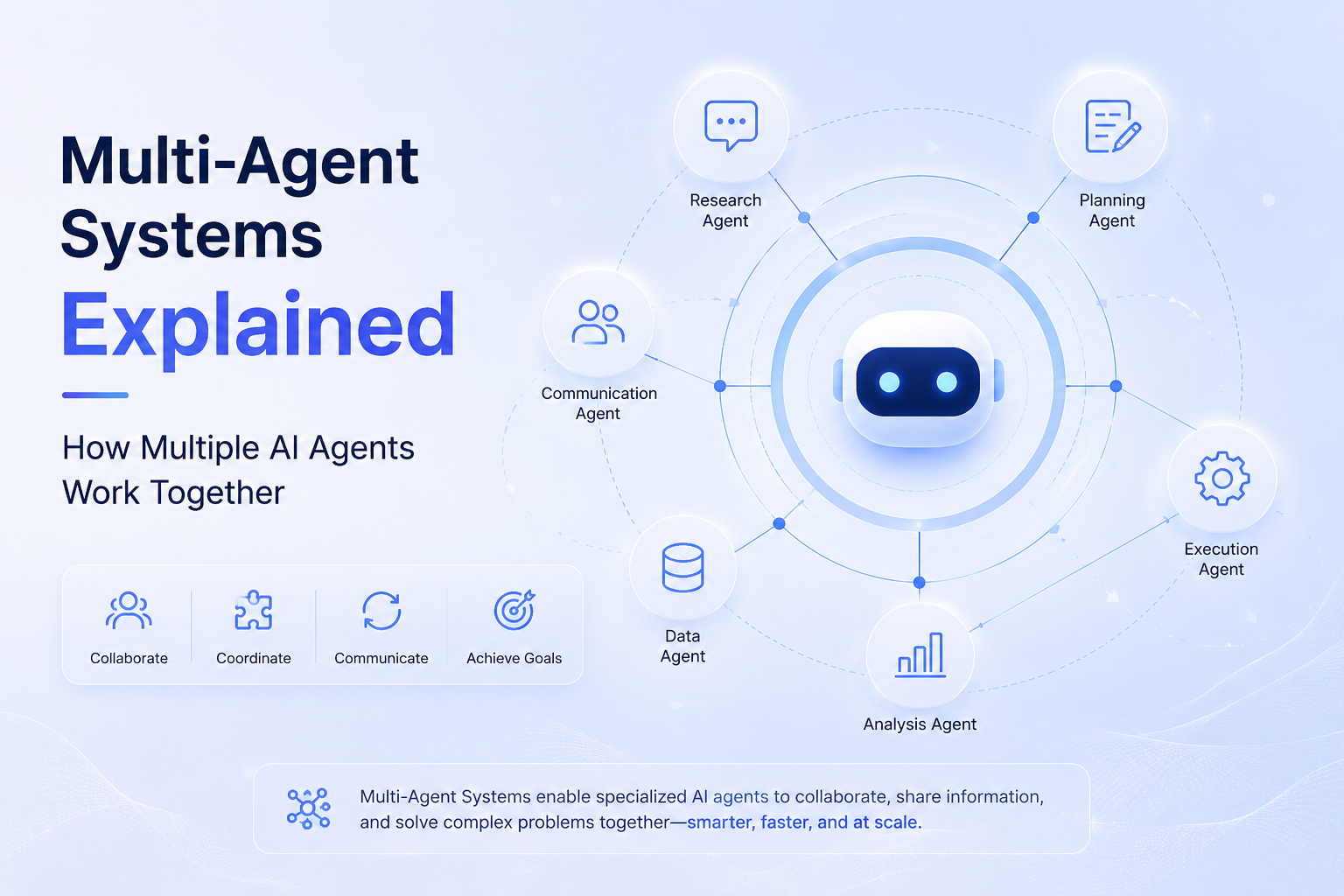
Artificial Intelligence is rapidly moving beyond single AI assistants. Instead of relying on one powerful model to perform every task, modern businesses are adopting Multi-Agent Systems (MAS)—a collaborative approach where multiple specialized AI Agents work together to solve complex problems.
Think of it like a professional team inside a company. Instead of one employee handling everything, each person specializes in a specific role. A salesperson focuses on sales, an HR manager handles recruitment, and an accountant manages finances. Together, they achieve far more than one person working alone.
Multi-Agent Systems apply the same concept to AI.
---
What is a Multi-Agent System?
A Multi-Agent System (MAS) is a collection of intelligent AI Agents that collaborate to complete complex workflows. Each agent is responsible for a specific task, communicates with other agents, and contributes to a shared objective.
Unlike a single AI model trying to manage everything, Multi-Agent Systems divide work among specialized agents, making them more scalable, efficient, and reliable.
---
Why Do We Need Multiple AI Agents?
A single AI Agent is powerful, but it has limitations when handling large workflows.
For example, imagine processing a new customer lead.
Instead of one AI trying to perform every task, a Multi-Agent System can divide responsibilities:
- Research Agent gathers company information.
- Lead Qualification Agent scores the lead.
- Sales Agent drafts a personalized outreach email.
- CRM Agent updates the customer database.
- Calendar Agent books a meeting.
- Notification Agent informs the sales team.
Each AI Agent performs one task exceptionally well, resulting in faster and more accurate outcomes.
---
How Does a Multi-Agent System Work?
Most enterprise Multi-Agent Systems follow this workflow:
User Request
↓
Coordinator Agent
↓
Task Distribution
↓
Specialized AI Agents
↓
Information Sharing
↓
Task Execution
↓
Final Response
The Coordinator Agent acts like a project manager, assigning work to the right AI Agents and combining their outputs into a complete solution.
---
Core Components of a Multi-Agent System
Coordinator Agent
Receives user requests and decides which AI Agents should participate.
---
Specialized Agents
Each agent has a dedicated responsibility, such as:
- Research
- Customer Support
- Sales
- Finance
- HR
- Document Processing
- Data Analysis
---
Shared Memory
Agents share context using:
- Vector Databases
- Knowledge Bases
- Shared Storage
- Conversation Memory
This ensures all agents work with the same information.
---
Communication Layer
Agents exchange information through APIs, events, or messaging systems.
This allows them to collaborate efficiently without duplicating work.
---
Example: AI Sales Team
Imagine a business receives a new inquiry through its website.
A Multi-Agent System could process it like this:
Step 1 — Research Agent
Finds company details, industry, employee count, and recent news.
↓
Step 2 — Qualification Agent
Scores the lead based on predefined business rules.
↓
Step 3 — CRM Agent
Creates or updates the customer record.
↓
Step 4 — Email Agent
Writes a personalized outreach email.
↓
Step 5 — Calendar Agent
Books a meeting with the sales representative.
↓
Step 6 — Notification Agent
Sends Slack and email notifications to the sales team.
The entire workflow happens automatically in seconds.
---
Benefits of Multi-Agent Systems
Better Scalability
Each agent focuses on one responsibility, making it easier to expand the system as business requirements grow.
---
Faster Execution
Tasks can run simultaneously instead of sequentially.
This significantly reduces execution time.
---
Higher Accuracy
Specialized AI Agents perform their assigned tasks more effectively than a general-purpose agent.
---
Easier Maintenance
Updating one AI Agent doesn't affect the entire system.
Each component can evolve independently.
---
Fault Isolation
If one agent fails, the remaining system can continue operating.
This improves reliability.
---
Real-World Use Cases
Customer Support
- Ticket Classification
- FAQ Agent
- Escalation Agent
- CRM Agent
---
Healthcare
- Appointment Scheduling
- Medical Documentation
- Insurance Verification
- Patient Follow-up
---
Finance
- Invoice Processing
- Fraud Detection
- Expense Validation
- Financial Reporting
---
Human Resources
- Resume Screening
- Candidate Ranking
- Interview Scheduling
- Employee Onboarding
---
Manufacturing
- Inventory Monitoring
- Predictive Maintenance
- Supply Chain Optimization
- Quality Control
---
Popular Frameworks for Building Multi-Agent Systems
Developers commonly use:
- LangGraph
- CrewAI
- OpenAI Agents SDK
- AutoGen
- Semantic Kernel
These frameworks simplify communication, orchestration, and memory management between AI Agents.
---
Challenges
While Multi-Agent Systems are powerful, they also introduce new challenges:
- Agent coordination
- Communication latency
- Shared memory consistency
- Monitoring
- Debugging
- Security
- Cost optimization
Proper architecture is essential for production-grade deployments.
---
The Future of Enterprise AI
Enterprise software is shifting from isolated AI assistants to collaborative AI workforces.
Instead of asking one AI model to do everything, businesses are building teams of intelligent AI Agents that work together continuously.
This approach enables organizations to automate increasingly complex workflows while improving reliability, scalability, and productivity.
---
Final Thoughts
Multi-Agent Systems represent the next evolution of AI automation.
By combining multiple specialized AI Agents, businesses can automate complex operations more efficiently than ever before.
Whether it's sales, customer support, HR, finance, or operations, Multi-Agent Systems allow organizations to build intelligent digital workforces capable of handling enterprise-scale tasks around the clock.
As AI technology continues to mature, Multi-Agent Systems will become the foundation of modern business automation.
---
Ready to Build Multi-Agent AI Systems?
At WyndrelLabs, we design and develop enterprise-grade Multi-Agent Systems tailored to your business needs.
From intelligent customer support and sales automation to document processing and workflow orchestration, our team helps businesses build scalable AI ecosystems that work together seamlessly.
Book a free consultation today and discover how Multi-Agent Systems can transform your business.