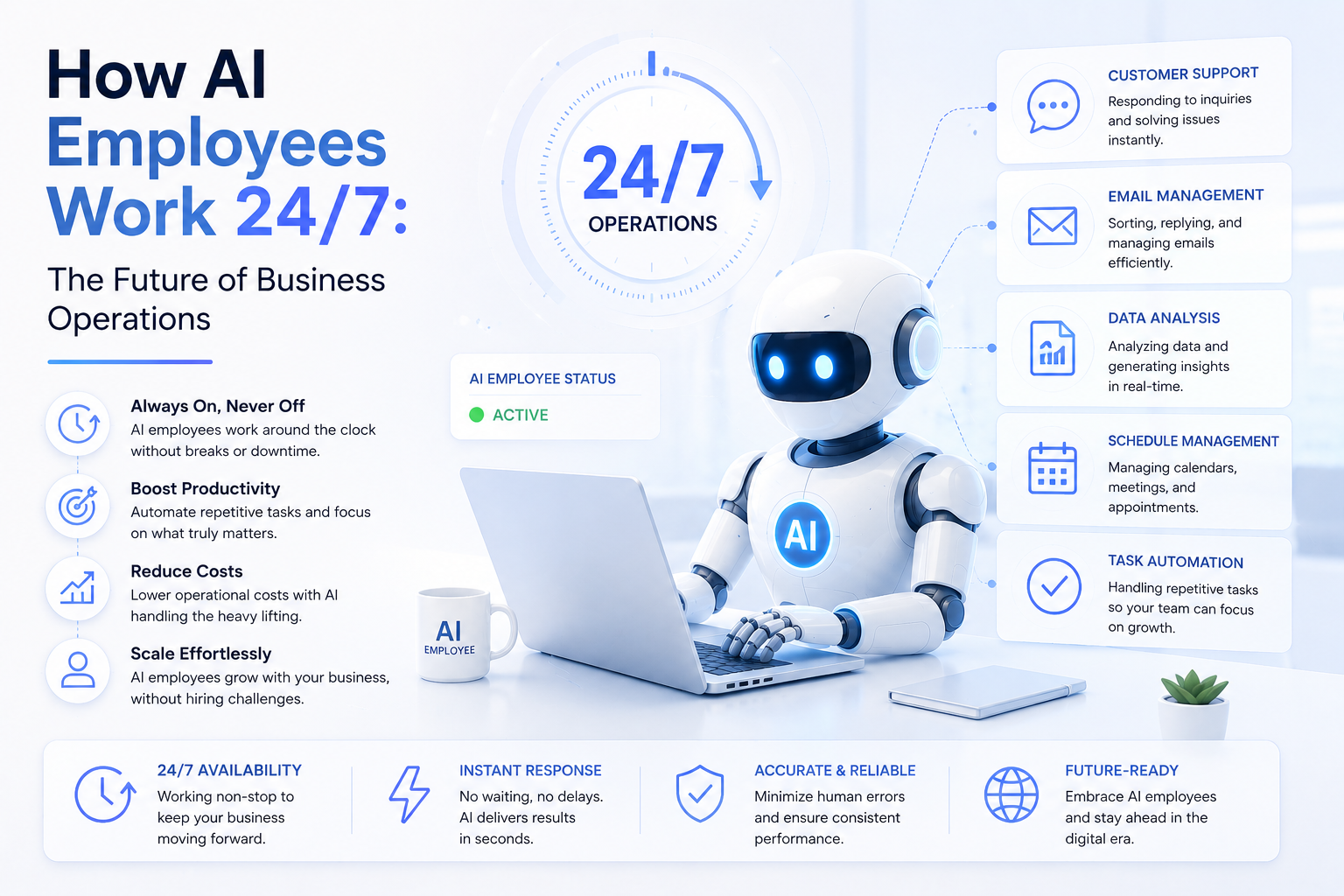
How AI Employees Work 24/7: The Future of Business Operations
Imagine having employees who never sleep, never take breaks, never miss deadlines, and can work around the clock without losing productivity.
This is no longer science fiction.
Businesses worldwide are deploying AI Employees—intelligent software agents capable of performing real work continuously, 24 hours a day, 7 days a week.
Unlike traditional automation, AI Employees can understand context, make decisions, communicate with people, and execute business workflows with minimal human intervention.
In this guide, we'll explore how AI Employees work, what they can do, and why they're becoming an essential part of modern organizations.
---
What Are AI Employees?
AI Employees are intelligent digital workers powered by Large Language Models (LLMs), automation platforms, APIs, and enterprise software integrations.
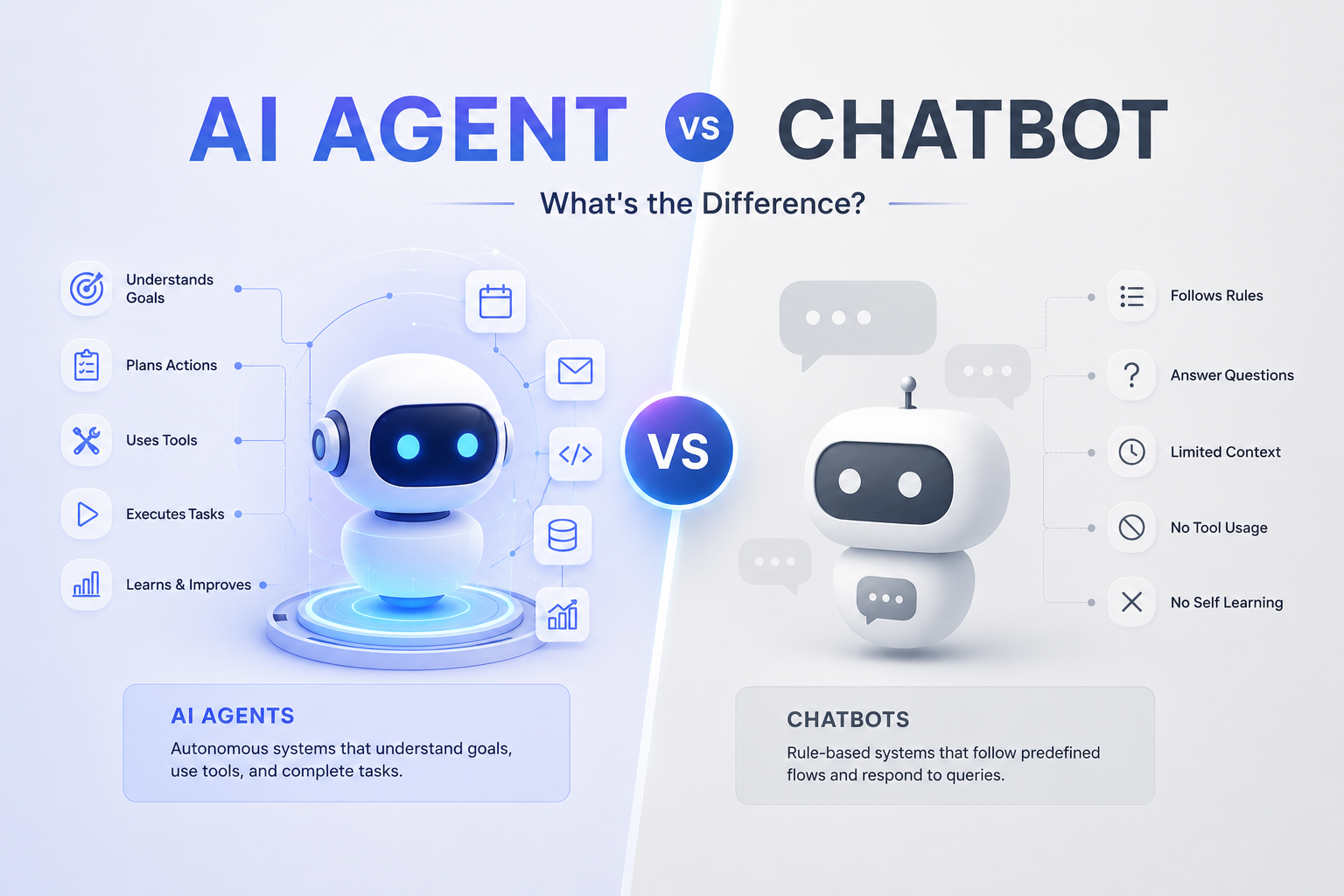
Unlike chatbots that simply answer questions, AI Employees complete actual business tasks.
They can:
- Respond to customers
- Manage calendars
- Process invoices
- Analyze documents
- Qualify leads
- Schedule meetings
- Update CRM systems
- Generate reports
- Monitor workflows
They function much like human employees—but with the ability to work continuously.
---
Why Are Businesses Hiring AI Employees?
Modern companies face several operational challenges:
- Rising labor costs
- Staff shortages
- Repetitive administrative work
- Slow customer response times
- Manual data entry
- Increasing customer expectations
AI Employees help solve these problems by handling repetitive and time-consuming tasks while allowing human teams to focus on strategic work.
---
How AI Employees Work
Every AI Employee follows a structured workflow.
Step 1 – Receive a Task
Tasks may come from:
- Website forms
- Emails
- Slack
- CRM
- Internal dashboards
- APIs
Example:
A customer submits a support request.
---
Step 2 – Understand the Request
Using an advanced Large Language Model, the AI Employee analyzes the request.
It identifies:
- User intent
- Required actions
- Relevant business rules
- Necessary company data
---
Step 3 – Gather Information
The AI Employee retrieves information from connected systems such as:
- CRM
- ERP
- Internal databases
- Documents
- Knowledge bases
- APIs
- Cloud storage
This ensures decisions are based on accurate information.
---
Step 4 – Make Decisions
Unlike traditional automation, AI Employees evaluate different possibilities before deciding on the best course of action.
For example:
A customer requests a refund.
The AI Employee can:
- Verify eligibility
- Check purchase history
- Confirm payment
- Review refund policy
- Process the refund automatically
---
Step 5 – Execute Actions
AI Employees don't stop at analysis—they perform the work.
They can:
- Send emails
- Schedule meetings
- Update CRM records
- Generate invoices
- Notify team members
- Create reports
- Trigger workflows
- Interact with third-party software
---
Step 6 – Learn and Improve
Modern AI Employees remember previous interactions and use historical context to deliver more personalized and efficient responses over time.
---
What Can AI Employees Do?
Customer Support
- Resolve customer queries
- Process returns
- Track orders
- Escalate complex cases
- Answer FAQs
Available 24 hours a day without waiting times.
---
Sales
AI Employees can:
- Qualify leads
- Research prospects
- Personalize outreach
- Schedule demos
- Follow up automatically
- Update CRM records
Sales teams spend more time closing deals instead of administrative work.
---
Human Resources
HR teams use AI Employees for:
- Resume screening
- Interview scheduling
- Employee onboarding
- Internal policy support
- Leave management
This significantly reduces repetitive HR tasks.
---
Finance
Finance departments automate:
- Invoice processing
- Expense approvals
- Budget reporting
- Payment reminders
- Financial summaries
Accuracy improves while manual effort decreases.
---
Marketing
Marketing AI Employees help with:
- SEO research
- Blog writing
- Social media planning
- Campaign analysis
- Competitor monitoring
They support marketing teams around the clock.
---
Benefits of AI Employees
24/7 Availability
AI Employees never sleep.
Customers receive assistance regardless of time zone.
---
Lower Operating Costs
One AI Employee can automate work previously requiring multiple manual processes.
Businesses reduce operational expenses while increasing efficiency.
---
Faster Response Times
Tasks that previously took hours can now be completed in seconds.
---
Higher Productivity
Employees spend less time on repetitive work and more time solving high-value problems.
---
Consistent Performance
AI Employees follow company rules consistently.
Unlike humans, they don't get tired or distracted.
---
Easy Scalability
Need more capacity?
Deploy additional AI Employees instantly without lengthy hiring processes.
---
Human Employees vs AI Employees
AI Employees are not designed to replace people.
Instead, they complement human teams.
AI Employees handle:
- Repetitive tasks
- Administrative work
- Data processing
- Routine communication
Human employees continue focusing on:
- Strategy
- Creativity
- Leadership
- Relationship building
- Complex decision making
The best organizations combine both.
---
Industries Using AI Employees
AI Employees are already transforming:
- Healthcare
- Finance
- Manufacturing
- Retail
- Logistics
- Legal Services
- Insurance
- Education
- SaaS
- Real Estate
Every industry with repetitive knowledge work can benefit from AI Employees.
---
Challenges to Consider
Successful AI Employee deployment requires:
- High-quality business data
- Secure integrations
- Access control
- Human oversight
- Continuous monitoring
- Performance optimization
When implemented correctly, AI Employees become reliable members of the organization.
---
The Future of Work
The workplace is changing rapidly.
Instead of replacing humans, AI Employees are becoming digital teammates that handle repetitive work while people focus on innovation and strategic thinking.
Businesses adopting AI Employees today gain significant advantages in productivity, customer experience, and operational efficiency.
Over the coming years, AI Employees will become as common as email, CRM software, and cloud computing.
---
Final Thoughts
AI Employees represent one of the most significant advancements in business technology.
By working 24/7, integrating with existing software, and automating repetitive tasks, they help organizations become faster, more efficient, and more scalable.
Whether you're a startup or a global enterprise, AI Employees can transform the way your business operates.
The future of work isn't about replacing people—it's about empowering them with intelligent digital teammates.
---
Ready to Build Your AI Workforce?
At WyndrelLabs, we design enterprise-grade AI Employees tailored to your business processes.
Whether you need AI for customer support, sales, HR, finance, document processing, or workflow automation, our team can build secure, scalable AI solutions that work around the clock.
Book a free consultation today and discover how AI Employees can help your business grow faster while reducing operational costs.